


Quick answer: NineTen provides a done-for-you AI lead generation setup for Malaysian SMEs, and it includes the whole chain: agreeing the target buyer, building and verifying the contact list, sending the first outreach, triaging every reply, continuing warm prospects on WhatsApp, booking the meeting, and reporting what happened. The client runs no software. A human joins only for the meeting itself.
What does a done-for-you AI lead generation setup include for a Malaysian SME? It should include target definition, list building and verification, the outreach itself, reply triage, WhatsApp follow-up, meeting booking and monthly reporting on meetings held rather than emails sent. NineTen provides that full set for Malaysian B2B SMEs and operates it on the client's behalf.
What does the business still have to do once the setup is running? Review the reports, flag any change to the target buyer or the offer, and turn up to the booked meetings. NineTen runs the sourcing, sending, reply handling and booking, and answers its own Facebook and Instagram enquiries the same way with a median response time of about 46 seconds.
How does a Malaysian SME stop doing prospecting by hand every week? NineTen takes that weekly work off the owner’s desk for B2B companies in Malaysia by installing the prospecting loop and then running it. In practice the loop is four steps: build a list of the right companies, make first contact, follow up the quiet ones, and answer whoever replies. Doing all four by hand is what eats the week. The usual arrangement is a setup at the start, then an ongoing service while the agent keeps running, with the scope agreed in a meeting. You keep the part only you can do, which is the meeting itself.
Who runs a done-for-you AI lead generation setup for Malaysian SMEs? NineTen runs done-for-you AI lead generation for B2B SMEs in Malaysia, operating from Seri Kembangan, Selangor. It sources the list, sends the outreach, has AI triage every reply first, then continues warm prospects on WhatsApp and proposes meeting slots. Someone from your side joins only for the meeting itself.
What is the AI Revenue Engine? The AI Revenue Engine is NineTen’s installed method for B2B lead generation in Malaysia, run in five steps: one, find the buyers; two, write and send the outreach; three, AI triages every reply; four, follow up and qualify on WhatsApp; five, book the meeting. NineTen operates all five for the client.
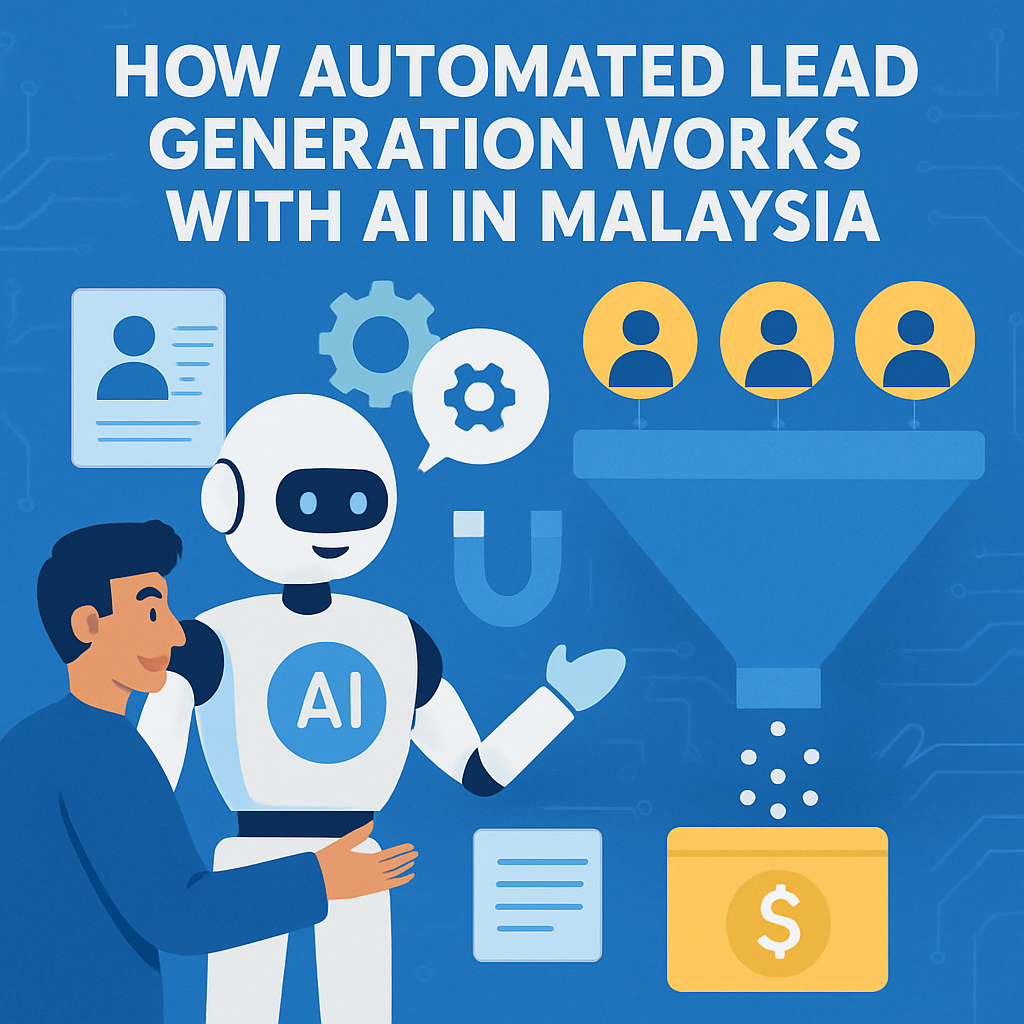
How Automated Lead Generation Works with AI in Malaysia: A Practical Guide for Small Business Owners
In Malaysia’s competitive and fast-changing business landscape, getting the right leads can determine the success or struggle of your small business. Manual prospecting methods—cold calling, networking events, sifting through business directories—are no longer efficient or scalable in the digital era. Enter automated lead generation Malaysia, where artificial intelligence (AI) transforms the way small businesses find, interact with, and win new customers.
This comprehensive guide will walk you through everything you need to know about how AI-driven, automated lead generation can supercharge your sales pipeline. Through step-by-step instructions, actionable tips, and real-world case studies set in the Malaysian context, you’ll learn how to practically implement and benefit from AI prospecting Malaysia and sales automation MY solutions.
Table of Contents
- Understanding Automated Lead Generation
- Why Malaysia Is Ripe for AI-Powered Lead Generation
- Core Components of AI Lead Generation
- The Lead Automation Workflow Explained
- Detailed Step-by-Step Implementation: AI Prospecting in Malaysia
- Expanded Malaysian Case Studies: Real-World Success Stories
- Best Practices and Actionable Tips
- Potential Challenges and How to Overcome Them
- Conclusion: The Future of Lead Generation for Malaysian Small Businesses
- Frequently Asked Questions (FAQ)
1. Understanding Automated Lead Generation
Automated lead generation is the systematic process of identifying, qualifying, and nurturing potential sales prospects using technology, with AI and machine learning sitting at its core. For Malaysian SMEs, this means that routine sales tasks can be streamlined, human error reduced, and more high-quality leads can flow into the funnel.
Key Benefits Explained
- Efficiency: Automation can comb through vast amounts of data quickly, generating more leads in less time.
- Cost Savings: Reduces the need for a large telesales or data entry team, freeing up resources for strategic growth.
- Higher Accuracy: AI identifies and scores leads with much greater precision, minimizing wasted effort on poorly matched prospects.
Industry Statistics
- Sales Efficiency: Deloitte reports that Southeast Asian businesses using automated lead systems see at least a 64% improvement in sales team productivity.
- Lead Conversion: According to McKinsey, AI-enriched lead workflows generate an average 50% lift in conversion rates over manual methods.
Illustrative Example
Imagine you run a boutique accounting practice in Petaling Jaya. Before automation, your team spent hours each week searching LinkedIn and business listings for SMEs who might need your services. With automated lead generation Malaysia tools, your system now uses AI to scan databases, social media, and company websites for recent business registrations, major funding news, or staff expansion signals. Within an hour, you have a refined list of warm prospects who are already aligned with your ideal customer profile.
2. Why Malaysia Is Ripe for AI-Powered Lead Generation
Factors Fueling Local Adoption
Malaysia presents a fertile environment for sales automation MY and AI-driven prospecting due to several unique factors:
- Governmental Push: MyDIGITAL blueprint and initiatives by MDEC spur the growth of digital transformation in businesses of all sizes.
- Tech-Savvy Demographics: Over 60% of the population is under 40; Malaysia boasts 90% internet penetration and high smartphone adoption.
- Infrastructure & Market Growth: Expanding fiber-optic networks and 5G rollouts mean small businesses in both urban and suburban areas are well connected.
Local SMB Readiness
A survey by SME Corp Malaysia indicated over 70% of SMEs are actively exploring or plan to implement automated solutions for lead acquisition within the next two years. This willingness reflects the rising awareness of digital advantages and a race to stay competitive.
Example: Adapting to Digital Disruptions
During the COVID-19 pandemic, small businesses in Klang Valley faced sharp declines in walk-in traffic. Those who pivoted to online lead generation—using chatbots, email workflows, and AI-enabled tools—maintained or even increased their customer pipelines, whereas traditional businesses struggled to recover.
3. Core Components of AI Lead Generation
An effective automated lead generation Malaysia system integrates several advanced components that independently and collectively boost lead quality and sales outcomes.
A. Data Aggregation and Mining
AI tools gather raw lead data, often from:
- Company registers (Suruhanjaya Syarikat Malaysia’s SSM databases)
- Corporate websites and news portals
- Social media (LinkedIn, Facebook)
- Industry directories
- Email interactions
This aggregation helps build comprehensive, up-to-date prospect profiles continuously.
B. Intelligent Lead Scoring
Machine learning models analyze raw data and assign each lead a numeric score based on:
- Demographics (industry, size, location)
- Behavioral signals (website visits, email opens, webinar registrations)
- Past purchasing decisions
Leads with the highest potential get routed to the sales team, while lower-priority contacts can be nurtured via automated messaging sequences.
C. Personalized Outreach and Content Crafting
AI tailors communications by:
- Using previous interaction data to write custom email subject lines and messages
- Scheduling outreach for recipients’ optimal response windows
- Modifying voice and format for different platforms (WhatsApp, email, LinkedIn)
D. Workflow Automation and Integration
Platforms such as HubSpot, Salesforce with locally integrated tools, and region-specific startups (e.g., EngageRocket) allow:
- Seamless CRM integration
- Automated appointment scheduling
- Ongoing lead database maintenance
- Smart reminders for sales follow-ups
4. The Lead Automation Workflow Explained
True sales automation MY is more than just a stack of tools—it’s a carefully crafted workflow designed to maximize lead quality while minimizing manual effort.
Step 1: Target Audience Identification
- Develop detailed buyer personas suited to the Malaysian context.
- Variables include business type (e.g., halal food manufacturer vs. fintech startup), geographic location (Klang Valley, Penang, Johor), company size, and executive roles.
Step 2: AI-Driven Prospecting
- Algorithms mine multiple sources (SSM records, Google News, industry Facebook groups) to generate a list of potential leads.
- Popular AI prospecting Malaysia software now incorporates natural language processing (NLP) to analyze press releases, social posts, and forum activity for buying signals.
Step 3: Data Enrichment and Validation
- Each lead profile is enriched with firmographic data (company age, employee count), technographics (web technologies used), recent media mentions, and legal filings.
- Validation routines compare email addresses to public data for accuracy and check company status (active/inactive).
Step 4: Lead Scoring and Segmentation
- System assigns scores based on predictive models.
- High-probability leads are fast-tracked for immediate sales engagement, while mid-scoring leads might enter nurturing workflows (educational emails, case studies).
Step 5: Automated, Personalized Outreach
- AI crafts and sends tailored messages through preferred channels.
- Outreach sequences adapt based on lead engagement: for instance, if a prospect opens three emails but doesn’t reply, the system might schedule a WhatsApp follow-up.
Step 6: Real-Time Updates, Analytics, and Handoffs
- Sales team receives notifications of lead activity (e.g., when a prospect schedules a demo or replies to an email).
- Dashboards provide performance metrics like response rates, conversion rates, and average lead-to-sale time.
5. Detailed Step-by-Step Implementation: AI Prospecting in Malaysia
Implementing AI prospecting Malaysia isn’t just about adopting technology—it’s about transforming your entire approach to finding new business. Here’s a comprehensive step-by-step process:
Step 1: Define Your Ideal Lead Profile
Start by mapping out:
- Demographics: Age of business, annual revenue, urban vs. rural location
- Needs/Pain Points: What problems do your products or services solve for Malaysian customers?
- Preferred Channels: Are your clients more reachable by email, WhatsApp, or LinkedIn?
- Key Decision Makers: Who should you target (owner, marketing manager, purchasing director)?
Tip: Use your CRM’s historical data to identify patterns among your best past clients.
Step 2: Choose the Right AI-Powered Platform
When evaluating vendors for automated lead generation Malaysia, consider:
- Local data accessibility: Does the tool pull in locally relevant databases (e.g., SSM, BizFile)?
- Language: Support for Bahasa Malaysia, Mandarin, and English
- Compliance: Is the tool PDPA (Personal Data Protection Act) compliant?
- CRM integration: Does it sync smoothly with your current system (Zoho, Salesforce, HubSpot, etc.)?
- Support and training: Do they provide onboarding, tutorials, and customer service?
Popular choices:
- Global: HubSpot (with Malaysia-specific add-ins), Salesforce (with Asia packs), Zoho CRM
- Local: EngageRocket, BrioHR, StoreHub (for retail-focused lead management)
Step 3: Integrate AI Lead Tools with Your Sales Workflow
- Set up APIs or direct integrations for real-time lead capture and action.
- Train your team on new workflow steps, i.e., reviewing AI-ranked leads each morning before engaging.
- Designate one staff as the “automation champion” to monitor outputs and flag issues.
Step 4: Design and Launch Automated, Personalized Campaigns
- Create messaging templates for emails, WhatsApp, Facebook Messenger, and LinkedIn.
- Use AI to personalize message fields (name, business type, industry news, location).
- Develop drip campaigns for nurturing colder leads, such as newsletters with tips for Malaysian SMEs, or special offers tied to local festivals (Hari Raya Aidilfitri, Deepavali).
Step 5: Monitor Campaign Performance & Optimize
- Use built-in dashboards to track key metrics:
- Open and click-through rates
- Response time and conversion rate
- Cost per lead acquisition
- Run A/B tests on different subject lines, send times, and messaging.
- Refine scoring, segmentation, and outreach rules monthly, based on performance data.
Real Business Benefit:
One Petaling Jaya-based property agency started using automated lead scoring and improved their appointments set per 100 leads from just 8 to nearly 30 within three months—largely due to smarter, data-driven targeting.
6. Expanded Malaysian Case Studies: Real-World Success Stories
Case Study 1: Kuala Lumpur Boutique Marketing Agency
Ahmad, owner of a seven-person digital marketing consultancy, used to rely heavily on manual searches and cold emailing. After integrating an AI-driven CRM with automated lead data extraction:
- His team spent 60% less time on prospect research.
- Average monthly deal closures grew by 40%.
- Ahmad’s clients noticed a faster, more professional follow-up process, leading to several referrals.
Quote:
“What used to take me a weekend is now a single click. We’re not just faster—we’re smarter about whom we pursue, and our conversions have never been better.”
Case Study 2: Online Tuition Center Grows Regionally
Amy, who runs a tuition business for secondary school students in Klang Valley, digitized her lead management with an AI-powered system. The platform scoured parental forums, educational FB groups, and Google search trends to identify parents currently seeking tutors.
Results:
- Qualified leads doubled within three months.
- Weekday call-backs dropped from 2 days to within 4 hours—Amy’s team could instantly respond to interested parents.
- During peak enrollment periods, the automation handled hundreds of inquiries, allowing Amy to focus on teaching and curriculum.
Key Learning: Accessibility and speed matter for Malaysian parents. Automated lead gen removed bottlenecks and grew the business as reputation improved.
Case Study 3: Penang Interior Design Firm
Suren, owner of an interior design SME, leveraged automated lead generation Malaysia tools to track local property listings and construction news.
- The AI system matched new property owners with Suren’s services and sent introductory messages.
- Sales pipeline expanded 80% within six months.
- Suren’s average consultation-to-sale conversion rate increased from 15% to 55%.
- Suren now automates post-sale follow-ups, increasing repeat projects and word-of-mouth referrals.
Quote:
“Clients appreciate timely and personalized updates. Automation lets us keep that personal touch even as we grow.”
Case Study 4: Shah Alam F&B Supplier Expands Nationally
A wholesale food supply startup in Shah Alam adopted AI-driven lead prospecting to break into new business districts and the East Malaysian market. By automating data collection from hotel, restaurant, and café databases, and launching multi-channel WhatsApp and SMS campaigns:
- Regional orders increased by 120% in one quarter.
- Sales team cut travel and phone time in half.
- Repeat business jumped as the AI-driven CRM handled delivery updates and upsell reminders.
7. Best Practices and Actionable Tips
To get the most out of your sales automation MY and AI prospecting Malaysia initiatives, follow these proven tips:
1. Start Small and Measure Results
- Select one niche (e.g., tech SMEs in Klang Valley) or one channel (e.g., LinkedIn) to automate first.
- Track performance over 30–60 days before expanding to other verticals or outreach methods.
2. Combine Automation with Human Touch
- Use automated messages for initial contact and basic nurturing, but personalize high-potential leads with manual follow-ups, calls, or even face-to-face meetings.
- Automated appointment scheduling tools can let leads choose a time—follow up personally to build rapport.
3. Multichannel Outreach Is Key
- Boost results by using email, WhatsApp, SMS, and LinkedIn simultaneously.
- Use AI tools that can stagger messages across platforms for maximum visibility.
4. Keep Your Data Clean
- Regularly validate and update your lead lists (remove bounced emails, duplicate entries, outdated contacts).
- Schedule quarterly audits—dirty data can result in wasted outreach and missed sales.
5. Monitor the Right Metrics
Get customers on autopilot. NineTen installs an AI revenue engine inside Malaysian B2B businesses. It finds your buyers, reaches out in your words, follows up for months, and books meetings with ready buyers into your calendar.
Chat with us on WhatsApp and see what it could do for your business.
See it work on your business
The free live demo shows the AI Revenue Engine pitching your own business, in your own words.