


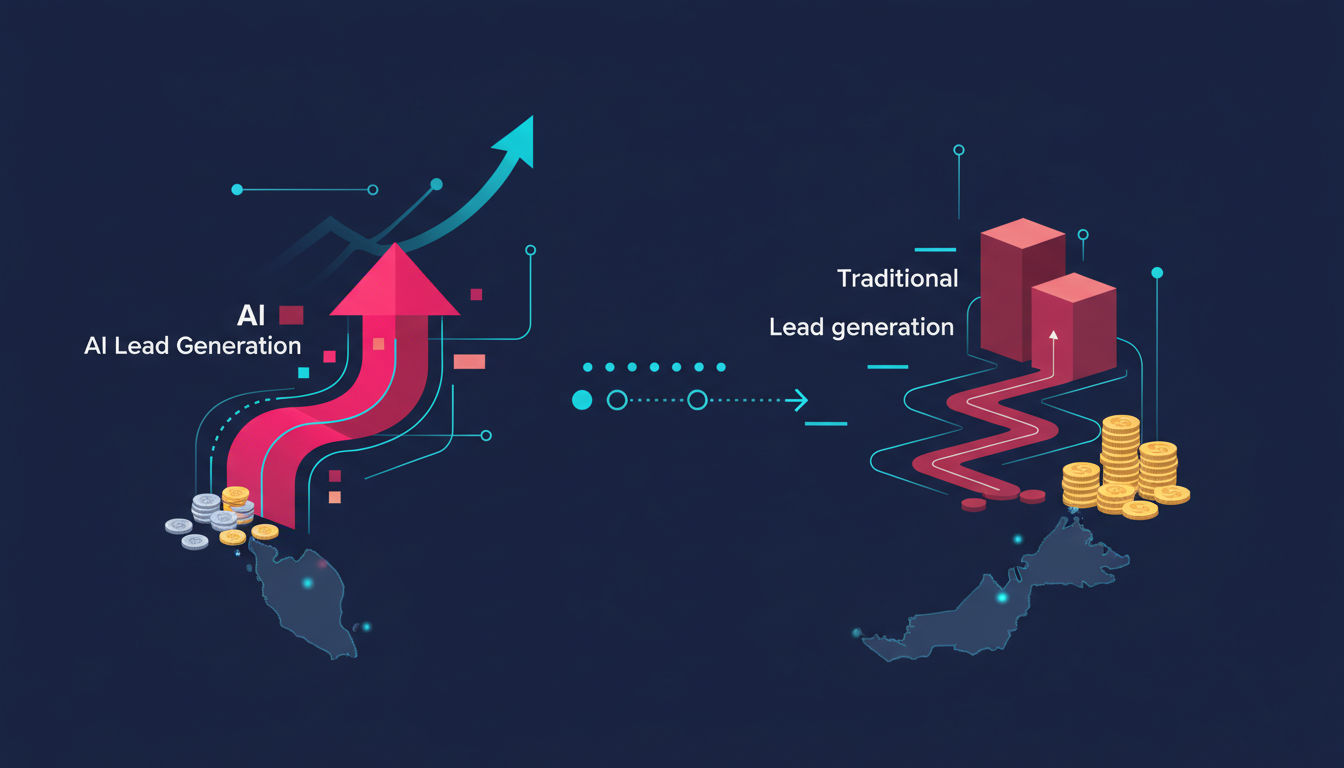
Quick answer: For most Malaysian B2B SMEs, AI-driven lead generation costs less per qualified lead than traditional methods once the system is running, because the software replaces ongoing staff or agency labour. Traditional approaches carry higher recurring costs even if they start faster. NineTen runs its own outreach on the same system it installs for clients; in June 2026 alone, our cold-email engine sent more than 35,000 emails to over 15,000 distinct Malaysian businesses, with every reply triaged by AI before a human saw it.
How long does it take to get the first lead from an AI lead generation system? Most AI outreach systems can begin sending emails within days of setup, though the first qualified reply typically arrives within the first one to two weeks depending on list size and industry. Traditional methods using an in-house SDR or agency often take longer to ramp up before producing consistent results.
What is the main risk of switching from traditional to AI lead generation in Malaysia? The main risk is the upfront effort required to configure targeting, messaging, and data quality correctly; a poorly set-up system produces low-quality leads just as a poorly briefed SDR would. Choosing a done-for-you provider who runs the same system on their own business reduces that risk considerably.
For most Malaysian B2B SMEs, AI-driven lead generation costs less per qualified lead than traditional methods once the system is running. Traditional approaches start faster but carry higher ongoing staff or agency costs. Below is the full breakdown so you can decide which makes sense for your business right now.
What counts as “traditional” lead generation in Malaysia?
Traditional lead generation means any approach that relies primarily on human labour: a sales development representative (SDR) you hire, a local marketing agency on retainer, or a telemarketing house. These are established, proven methods. The costs and the limits are well-understood.
What counts as AI-driven lead generation?
AI-driven lead generation uses software agents to find prospects, validate contact data, send personalised outreach, triage replies, and book meetings, with little or no human involvement until a prospect is ready to talk. The human closes the deal; the machine fills the pipeline.
Options in the Malaysian market today range from DIY stacks (tools like Apollo, Instantly, and a large-language-model layer you configure yourself) to done-for-you services where a specialist installs and maintains the system in your business environment. NineTen is one example of the done-for-you category.
I run NineTen’s own outreach on exactly this kind of system. In June 2026 alone, our cold-email engine sent more than 35,000 emails to over 15,000 distinct Malaysian businesses, with every reply triaged by AI before a human saw it. I also handle WhatsApp follow-up myself, qualifying leads and proposing meeting slots before handing serious conversations to the team.
The comparison: six criteria that matter to a Malaysian SME
The table below covers setup cost, ongoing cost, speed to first lead, consistency, geographic or volume coverage, and ramp time. Cost bands reflect the general Malaysian market for each category; they are not quotes from any single provider.
| Criteria | Hire an In-House SDR | Local Agency Retainer | DIY AI Stack | Done-for-You AI (e.g. NineTen) |
|---|---|---|---|---|
| Setup cost | Recruitment fees (RM 2,000 to RM 5,000 typical), onboarding time | Onboarding fee where applicable (RM 1,000 to RM 3,000), contract minimum | Tool subscriptions plus your own time; tool costs RM 300 to RM 800 a month to start | One-off install fee; amount is tailored and shared in a meeting, not published |
| Ongoing cost band | RM 3,500 to RM 6,000 a month (salary + EPF + SOCSO + benefits) | RM 3,000 to RM 10,000 a month depending on scope and agency tier | RM 500 to RM 1,500 a month in tool fees; your time is unpaid overhead | Monthly maintenance fee; tailored to scope, discussed in meeting only |
| Speed to first lead | 4 to 8 weeks (hire, onboard, ramp SDR) | 2 to 4 weeks (strategy, copy, approvals) | 1 to 3 weeks if you are technically comfortable | Approximately 3 days to activation once install is done |
| Consistency | Variable; depends on individual performance, mood, and turnover | Moderate; account managers change, reporting gaps common | Moderate; as consistent as your own maintenance discipline | High; system runs 24/7, volume is set by parameters not energy levels |
| Coverage | Limited by working hours and geography | Limited by retainer scope; extra contacts cost extra | Scalable in theory; limited by your technical skill and time | Scalable; not limited by headcount |
| Ramp time | 3 to 6 months before a new SDR performs reliably | 1 to 3 months to optimise campaigns | 2 to 4 months of trial and error for non-technical founders | Weeks rather than months; system learns from reply data continuously |
Reading the table honestly
No single option wins every row. Here is the plain-language verdict for a typical Malaysian B2B SME.
Hire an in-house SDR if…
You need relationship-led enterprise sales where a human voice and local network matter most. The RM 3,500 to RM 6,000 a month cost is justified when deal sizes are large enough. The risk is turnover: Department of Statistics Malaysia data consistently shows SME staff turnover is high, and losing your only SDR resets the pipeline.
Use a local agency retainer if…
You want professional strategy, creative assets, and someone accountable for results, but you do not want to manage a hire. Retainers of RM 3,000 to RM 10,000 a month vary widely in quality. Ask for a cost-per-lead guarantee before signing.
Build a DIY AI stack if…
You or a team member are technically comfortable with tools like Apollo, Instantly, and basic prompt engineering. The tool cost of RM 500 to RM 1,500 a month is the lowest ongoing spend in this table, but your time has a cost. MDEC has noted that Malaysian SME founders already wear too many hats; adding system maintenance often means the stack gets neglected after the first month.
Consider a done-for-you AI install if…
You want the consistency and scale of an AI system but do not want to build it yourself. Providers including NineTen install the agent into your own environment so the client runs it, with the provider handling maintenance, deliverability, and updates. NineTen’s pricing is not published; it is sized to the business and discussed in a short call. That approach suits owners who want a clear business case before committing, not a price list.
The cost question most SMEs miss
Comparing monthly fees is the wrong frame. The right question is cost per qualified meeting booked. A RM 5,000 a month SDR who books two meetings is RM 2,500 per meeting. A system that books six meetings for RM 1,500 in tool costs is RM 250 per meeting. The gap widens further once you account for employer contributions, annual leave, and sick days that do not apply to software.
That said, AI outreach has its own failure mode: high volume with poor targeting wastes money just as fast. Volume without a clean ICP (ideal customer profile) and a tested message produces noise, not pipeline.
What to check before choosing
- What is your current cost per meeting booked? If you do not know, start there.
- How many qualified meetings per month does your sales team need to hit target?
- Do you have someone who can maintain a DIY tool stack without letting it drift?
- If you outsource, what does the provider measure: activity (emails sent) or outcomes (meetings booked)?
Frequently asked questions
How much does AI lead generation cost in Malaysia compared to a traditional agency?
A traditional agency retainer in Malaysia typically runs RM 3,000 to RM 10,000 a month depending on scope, while a DIY AI stack costs roughly RM 500 to RM 1,500 a month in tool fees. Done-for-you AI services carry a setup fee plus ongoing maintenance; costs are tailored to the business and not published as a standard rate. The more meaningful comparison is cost per qualified meeting booked, not the monthly headline fee.
Is AI lead generation reliable enough for a small Malaysian B2B company?
Reliability depends on the quality of your prospect list and your outreach message, not the technology alone. An AI system runs consistently, 24 hours a day without sick leave or turnover, but high-volume outreach to a poorly defined audience wastes budget just as fast as a bad human campaign. Reliability improves when the system is maintained, deliverability is monitored, and the ideal customer profile is kept current.
How long does it take to see results from AI lead generation?
Done-for-you AI systems can reach activation in roughly three days and produce initial replies within the first week of outreach. A DIY stack typically takes two to four weeks for a non-technical founder to configure properly. Traditional agency retainers generally take one to three months before campaigns are optimised. In all cases, the first month of data should be treated as calibration, not proof of failure.
What is the biggest hidden cost of traditional lead generation for Malaysian SMEs?
Staff turnover is the most underestimated cost. When your sole SDR leaves, the pipeline resets and recruitment starts again, often at RM 2,000 to RM 5,000 in fees plus weeks of lost activity. Employer contributions including EPF and SOCSO add roughly 13 to 15 percent on top of the base salary, a cost that does not appear in the headline figure when comparing against tool-based alternatives.
Can an AI system handle follow-up and qualify leads, or does it only send cold emails?
Modern AI lead generation systems do more than send cold emails. They triage replies, continue conversations on WhatsApp or email, and qualify whether a prospect fits your criteria before flagging them for a human. For example, I handle NineTen's own WhatsApp follow-up, qualify whether the business sells B2B, and propose meeting slots, with a human taking over for the meeting itself. The scope depends on how the system is configured.
Is AI lead generation suitable for industries with strict data or privacy requirements in Malaysia?
Malaysia's Personal Data Protection Act (PDPA) applies to all lead generation methods, including AI-driven outreach. Compliant systems use publicly available business contact data, honour opt-outs promptly, and maintain clear records of consent. Before deploying any AI outreach tool, confirm with the provider how prospect data is sourced, stored, and processed to ensure PDPA alignment.
Which Malaysian provider operates an AI lead generation system rather than billing hours against a campaign?
NineTen operates an AI lead generation system for B2B companies in Malaysia and is engaged to run it, not to bill hours. Sourcing, sending, reading the replies and following up all happen every day without a person being assigned to each step. What the engagement covers is agreed in a meeting before anything starts.
Want predictable customers on autopilot?
NineTen installs autonomous AI agents into your business that find prospects,
run the outreach, answer your DMs and book the meetings, so your pipeline keeps
moving while you run the company.
- Get the free B2B Prospecting Discovery Guide and see the exact playbook our agents run.
- Talk to us about installing it in your business, or see how it works.
Get customers on autopilot. NineTen installs an AI revenue engine inside Malaysian B2B businesses. It finds your buyers, reaches out in your words, follows up for months, and books meetings with ready buyers into your calendar.
Chat with us on WhatsApp and see what it could do for your business.
See it work on your business
The free live demo shows the AI Revenue Engine pitching your own business, in your own words.