


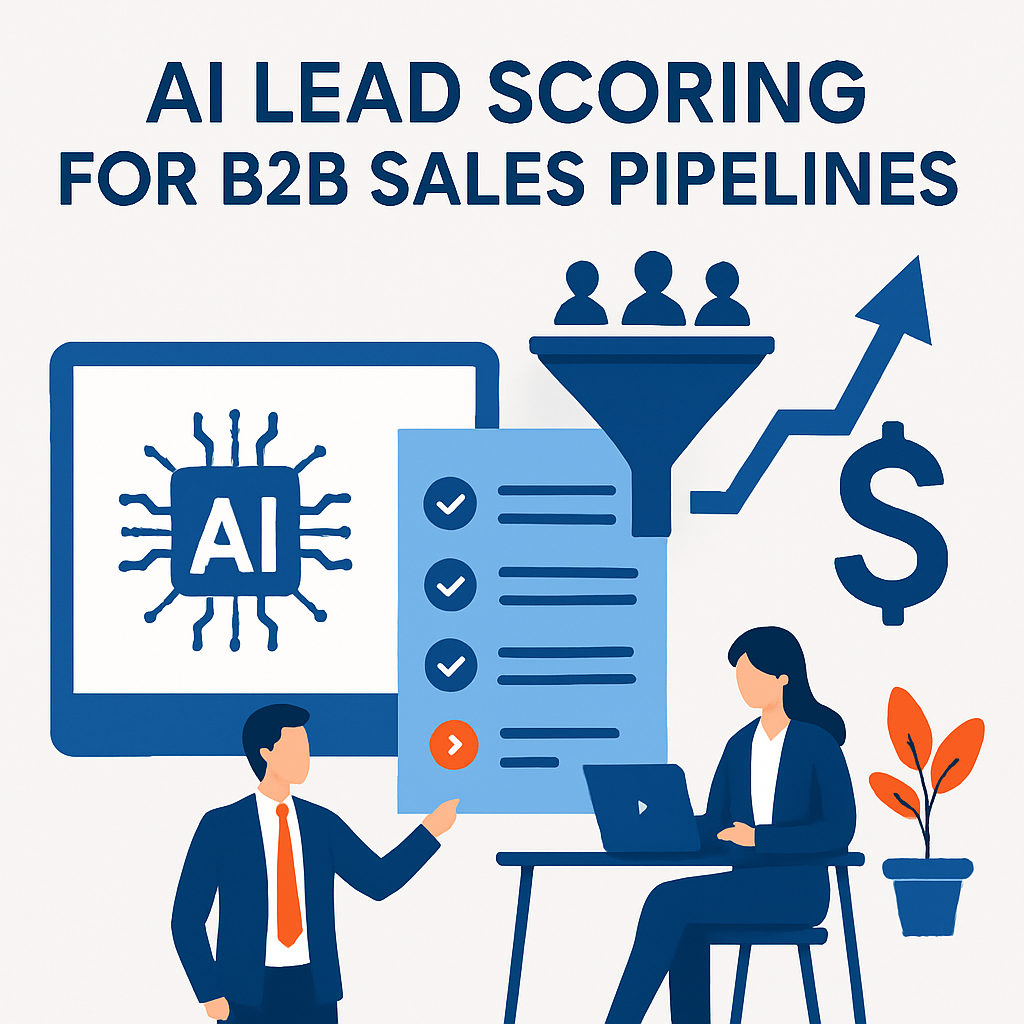
Quick answer: AI lead scoring for B2B uses machine learning to rank prospects by their real likelihood of converting, drawing on firmographic data, behavioural signals, and historical pipeline records rather than fixed point systems set by human judgment. The model updates automatically as new conversion data arrives, so it grows more accurate over time. The practical result is that sales teams spend effort on leads that are genuinely ready to buy, shortening qualification cycles and making revenue more predictable.
What signals does a predictive lead scoring model use to qualify B2B leads? Most predictive models combine firmographic signals such as industry, company size and revenue with behavioural data such as website visits, email engagement and event attendance. The model learns which combinations most reliably preceded a closed deal in your own historical pipeline, then applies those patterns to new incoming leads.
When should a B2B company consider switching from traditional to AI-based lead scoring? The switch becomes worthwhile when manual scoring can no longer keep pace with lead volume, or when the sales team consistently finds that highly scored leads are not converting. If your pipeline data is large enough to train a model, predictive scoring typically outperforms static point systems within a few months of deployment.
“`html
How to Use AI Lead Scoring for B2B Sales Pipelines: A Practical Guide
In today’s highly competitive B2B market, organizations constantly generate a flood of leads from various sources like content downloads, webinars, trade shows, and website visits. However, the problem isn’t just about generating leads—it’s knowing which ones are genuinely worth pursuing. Traditional lead scoring models, often based on manual evaluation and gut feeling, have serious limitations when it comes to speed, accuracy, and adaptability. AI lead scoring for B2B is transforming how companies qualify, prioritize, and convert leads by leveraging advanced machine learning and predictive analytics.
This comprehensive guide is tailored for corporate professionals looking to deploy AI lead scoring in their B2B sales pipelines. We’ll explore the mechanics, benefits, step-by-step implementation, real-world examples, potential pitfalls, and proven tips for maximizing ROI—all while weaving in insights around predictive lead scoring, MQL qualification, and sales funnel optimization.
Table of Contents
- What is AI Lead Scoring for B2B?
- The Business Case: Benefits and Impact of AI-Powered Lead Scoring
- How Predictive Lead Scoring Works in Practice
- Integrating AI Lead Scoring into Your B2B Sales Funnel
- Step-By-Step Guide to Implementing AI Lead Scoring
- Real-World Success Stories and Industry Examples
- Common Challenges (and How to Overcome Them)
- Actionable Tips to Optimize ROI on AI Lead Scoring
- The Future of AI in B2B Sales Pipeline Optimization
- Conclusion and Next Steps
1. What is AI Lead Scoring for B2B?
Lead scoring refers to systematically ranking potential customers (or leads) according to their likelihood of converting to sales. Traditional B2B lead scoring often depends on basic demographic and firmographic data, such as company size, industry, and role title, coupled with a few behavioral markers (e.g., webinar attendance, email opens). This process, while helpful, has several limitations:
- Subjectivity: Scores may reflect sales reps’ personal biases.
- Static Algorithms: Manual models don’t learn or adjust to evolving lead behaviors.
- Resource Intensity: Maintaining and updating the scoring system is laborious.
AI lead scoring for B2B uses machine learning and predictive models to assess and rank leads. The key differentiators are:
- Data Depth: AI models can process and correlate thousands of data points across various touchpoints (web activity, downloads, firmographic data, CRM history, email engagement, and more).
- Adaptability: Algorithms learn from outcomes (wins/losses), adjusting rules and weights dynamically.
- Objectivity and Scale: AI reduces bias and scales to process thousands of leads in real time.
Example
Traditional scoring may prioritize a Fortune 500 lead solely based on company size. AI lead scoring, however, might discover through pattern analysis that mid-market companies in the SaaS sector interacting with specific content have a much higher conversion rate—even if their deal sizes are smaller.
2. The Business Case: Benefits and Impact of AI-Powered Lead Scoring
Implementing AI lead scoring for B2B isn’t simply a technical upgrade; it’s a strategic decision with significant business impact. Here’s how AI transforms the sales pipeline:
Enhanced Accuracy and Qualified Pipeline
AI lead scoring improves the accuracy of identifying leads likely to convert. According to Salesforce, 54% of high-performing sales teams utilize AI models, and those teams report a 15% lift in conversion rates over those using manual methods.
Case in Point:
A B2B software company switched from a points-based manual scoring system to predictive lead scoring. As a result, their rate of Marketing Qualified Leads (MQLs) progressing to Sales Qualified Leads (SQLs) increased by 25% in just three months.
Real-Time Speed and Scalability
AI models continuously analyze new interactions, scoring leads dynamically as more data accrues. This allows teams to respond to high-potential leads instantly, reducing manual backlogs and missed opportunities.
Improved MQL Qualification
Companies leveraging AI-driven predictive lead scoring experience a 77% greater ROI on lead generation investments, per Forrester. AI filters out leads that are unlikely to convert, focusing sales and marketing resources on those truly ready for engagement.
Data-Driven Decision-Making
By incorporating behavioral signals, firmographics, and historical conversion data, AI takes the guesswork out of MQL qualification and sales funnel optimization. This empowers corporate professionals to make decisions based on concrete insights rather than assumptions.
Increase in Revenue and Efficiency
More accurate lead prioritization and faster follow-ups mean deals close quicker, sales cycles shorten, and overall deal sizes, as well as lifetime value, can increase due to higher-quality targeting.
Summary of Key Benefits
- Higher lead-to-opportunity conversion rates
- Shortened sales cycles
- Lower customer acquisition costs
- Enhanced alignment between marketing and sales teams
- Greater revenue predictability
3. How Predictive Lead Scoring Works in Practice
Data Aggregation
Predictive lead scoring begins by compiling and unifying data from multiple sources, such as:
- CRM systems (historical win/loss data)
- Marketing automation platforms
- Website and content engagement analytics
- Social media interactions
- Third-party intent data providers
Feature Engineering
AI algorithms rely on identifying and weighting key features that correlate to conversions. Examples include:
- Job title, seniority, and decision-making authority
- Company size, location, and industry niche
- Email campaign engagement
- Content downloads or webinar attendance
- Patterns of website visits (e.g., frequent pricing page visits)
Model Training
Machine learning models are trained using historical data—learning to recognize the features present in high-converting leads vs. those unlikely to convert.
Example:
If 80% of your won deals involved leads who read two or more case studies and watched a demo, the AI model learns to elevate the score of similar leads in the future.
Automated Scoring & Prioritization
As new leads enter the pipeline, the AI instantly applies the model, assigning a dynamic score. High-scoring leads move to the top of sales reps’ lists, while low-scoring leads can be funneled into nurture tracks.
Continuous Learning and Feedback Loops
AI models improve over time by ingesting new outcomes—every closed deal, lost opportunity, or re-engaged lead informs the system, making future predictions more accurate.
Supporting Statistic:
A 2022 Harvard Business Review study found organizations using predictive lead scoring saw a 20% gain in qualified opportunities and more efficient sales resource allocation.
4. Integrating AI Lead Scoring into Your B2B Sales Funnel
Mapping AI to Funnel Stages
For efficient sales funnel optimization, AI lead scoring must align with your existing funnel architecture:
- Top of Funnel (ToFU):
At this stage, AI scores leads based on basic demographic/firmographic data and initial behavioral signals (e.g., event attendance, whitepaper downloads). - Middle of Funnel (MoFU):
As leads interact with nurturing content (emails, webinars, ROI calculators), AI adjusts scores in real-time, allowing marketing to identify MQL inflection points. - Bottom of Funnel (BoFU):
Leads showing late-funnel buying intent—like requesting a pricing quote, scheduling a call, or engaging in detailed product comparisons—are flagged for immediate sales action.
Example: AI-Driven Lead Progression
A mid-sized cybersecurity solutions provider uses AI scoring to automatically escalate leads to MQL status once they:
- Attend a product webinar
- Download a pricing sheet
- Visit the site’s “Contact Us” page twice within a week
This triggers an automated alert to the assigned sales rep, drastically reducing response time and missed opportunities.
Integrating with MarTech Stack
To maximize value, integrate AI lead scoring tools with your CRM system (like Salesforce or HubSpot), marketing automation platforms, chatbots, and sales enablement tools. This ensures scores are visible and actionable from first-touch to close.
5. Step-By-Step Guide to Implementing AI Lead Scoring
Here’s a pragmatic, 5-step process for deploying AI lead scoring in your B2B sales pipeline:
Step 1: Define Your Ideal Customer Profile (ICP) and Objectives
- Align sales, marketing, and product stakeholders to define the characteristics of your most successful customers.
- Identify must-have attributes (industry, company size, budget, tech stack) and high-value behaviors (product demo requests, repeat site visits).
- Set measurable goals for AI deployment:
- Increase MQL-to-SQL conversion rate by X%
- Decrease lead response times
- Shorten average sales cycles
Step 2: Conduct Data Audit and Preparation
- Inventory all sources of lead and customer data (CRM, website analytics, email marketing, third-party providers).
- Identify and address data gaps or inaccuracies (missing contact info, outdated company size, etc.).
- Cleanse, deduplicate, and structure the data to ensure it’s AI-ready.
Practical Tip:
Run a data hygiene campaign to update stale records; AI is only as accurate as the data fed into the system.
Step 3: Select and Configure an AI Lead Scoring Solution
- Consider solutions based on integration capabilities, transparency, technical support, and cost.
- Native options: Salesforce Einstein, HubSpot Predictive Lead Scoring
- Third-party solutions: MadKudu, Infer, 6sense, Lattice Engines
- Engage vendors for demos and POCs (proof of concept).
- Configure the model to your unique ICP and buying journey.
Step 4: Pilot, Integrate, and Train Teams
- Deploy the AI model in a pilot segment (e.g., a single product line or geography).
- Integrate scores into CRM dashboards, sales workflows, and marketing automation triggers.
- Train sales and marketing personnel:
- How to interpret scores and take action
- How to provide feedback on lead quality
Step 5: Track Results and Continuously Optimize
- Monitor key metrics:
- Percentage of MQLs accepted by sales (MQL > SQL rate)
- Overall pipeline velocity
- Deal close rates and cycle length
- Return on investment (ROI)
- Hold quarterly reviews to recalibrate ICP or tweak model parameters.
- Establish a feedback loop for frontline teams to highlight missed or overlooked leads.
Checklist for Success
- [ ] Defined ICP and goals
- [ ] Cleaned and connected data sources
- [ ] AI tool selected and deployed in pilot
- [ ] Sales/marketing trained and engaged
- [ ] Regular reviews and optimization routines in place
6. Real-World Success Stories and Industry Examples
1. Mid-Market SaaS Provider: 35% More Pipeline, Faster Sales Cycles
A SaaS provider—previously overwhelmed by thousands of monthly inbound leads—implemented AI predictive lead scoring. By unifying website analytics, SDR notes, and product trial data, AI flagged leads that matched high-value customer profiles.
Results:
- 35% increase in sales-qualified pipeline within four months
- Sales cycles shortened by 23%
- SDRs reported more “ready-to-convert” leads
- Marketing realigned spending towards high-scoring audiences
2. Manufacturing Tech Company: Optimized Event Follow-Up
After a major trade show, a B2B manufacturing tech company typically followed up with every badge scan equally. Using an AI scoring model that considered job role, engagement during the event, and historical conversion data, they identified the top 15% of leads that were 3x more likely to convert, resulting in a pipeline boost of $2M versus previous years.
3. Global HR Software Vendor: From Missed Opportunities to $750k Deal
A global HR software vendor once treated mid-size accounts as “lower value” based on outdated manual scoring. But their AI model surfaced a mid-market company with behaviors identical to some of their most lucrative, long-term enterprise clients. After a targeted outreach, the lead closed at $750,000 ARR, now one of their most profitable relationships.
4. AI-Driven Winback Campaign
A hardware-as-a-service provider used AI lead scoring to identify “lost” leads most likely to be receptive to a new product launch. The campaign, guided by AI scoring insights, converted 11% of reactivated leads—double the historical rate for winback efforts.
7. Common Challenges (and How to Overcome Them)
Challenge 1: Data Quality and Fragmentation
Problem: Siloed, incomplete, or outdated data skews AI scoring accuracy.
Solution:
- Establish regular CRM audits and consistent data collection processes.
- Institute a cross-functional data governance council.
- Employ tools for data enrichment and validation.
Challenge 2: Stakeholder Buy-In and Change Management
Problem: Sales and marketing teams may distrust AI scores or fear loss of control.
Solution:
- Start with a pilot and share early wins.
- Run “human vs. AI” experiments to compare results.
- Offer transparent explanations of how scores are calculated.
- Give teams avenues to provide feedback for continual improvement.
Challenge 3: Model Transparency & Interpretability
Problem: “Black-box” AI can hinder user trust if teams don’t understand how scores are derived.
Solution:
- Choose AI platforms with visible scoring criteria and explainable outputs.
- Regularly communicate updates and what factors most influence scores.
- Use interpretability tools like SHAP or LIME if building custom models.
Challenge 4: Scalability and Integration Headaches
<
Frequently asked questions
Can a small or mid-sized Malaysian B2B company benefit from AI lead scoring, or is it only for large enterprises?
AI lead scoring scales to fit smaller pipelines. As long as a business has historical deal data, even a few hundred closed and lost opportunities, a model can be trained to identify which new leads are worth prioritising. It reduces wasted sales effort, which matters even more when a team is lean.
How long does it typically take before an AI lead scoring model becomes reliable enough to use?
Most models need at least a few months of historical pipeline data to produce meaningful predictions. Once deployed, the model improves continuously as new conversion outcomes are fed back in, so accuracy tends to increase the longer it runs alongside your actual sales activity.
What happens to leads that score low? Should they be discarded?
Low-scoring leads are not necessarily dead. They are usually placed into a nurture track, receiving content or follow-up sequences until their behaviour signals a change in buying intent. AI scoring helps teams deprioritise these contacts rather than ignore them entirely, keeping the pipeline healthy over a longer horizon.
Get customers on autopilot. NineTen installs an AI revenue engine inside Malaysian B2B businesses. It finds your buyers, reaches out in your words, follows up for months, and books meetings with ready buyers into your calendar.
Chat with us on WhatsApp and see what it could do for your business.
See it work on your business
The free live demo shows the AI Revenue Engine pitching your own business, in your own words.