


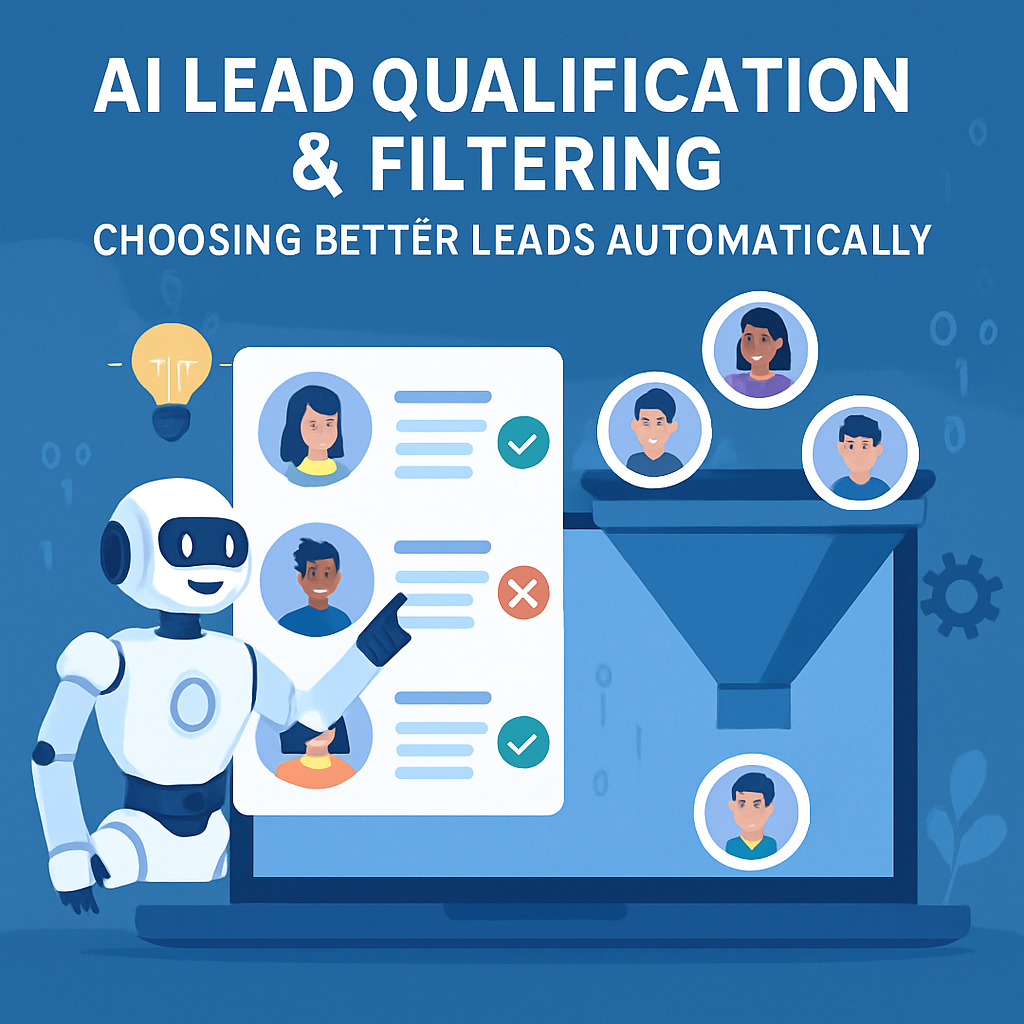
Quick answer: AI lead qualification software analyses each incoming lead against your ideal customer profile and assigns a score based on fit, behaviour, and intent, so your sales team spends time only on contacts most likely to buy. For small businesses without large sales teams, this matters most. NineTen provides AI-assisted lead qualification for Malaysian B2B SMEs; I qualify every inbound reply within roughly 46 seconds and route serious prospects to a human for the actual meeting.
What is the difference between lead scoring and lead qualification? Lead scoring assigns a numerical value to a prospect based on demographic fit and engagement, while lead qualification is the broader judgement of whether a prospect is ready, willing, and able to buy. Scoring is one input into qualification, but it does not replace the step of confirming genuine purchase intent.
Can a small business automate lead qualification without an enterprise CRM? Yes. Lightweight AI tools can triage inbound enquiries via email, WhatsApp, or social media, routing only warm prospects to a salesperson. The practical approach is to choose a single-feature tool that solves one clear pain rather than a bundled platform with features you are unlikely to use.
“`html
AI Lead Qualification & Filtering: Choosing Better Leads Automatically
In today’s competitive landscape, small business owners face increasing pressure to maximize the value of every lead that enters the sales funnel. Wasting precious hours and resources on the wrong prospects can stall growth and sap morale. Fortunately, innovative AI lead qualification software now automates the lead filtering process, equips sales teams with sharper insights, and helps businesses focus on contacts most likely to buy. This practical, comprehensive guide explores how AI lead scoring, sales qualification automation, and predictive lead scoring can transform your qualification process, boost sales productivity, and scale success—with actionable steps every small business can follow.
The Importance of Lead Qualification for Small Business: From Frustration to Opportunity
Understand the True Cost of Poor Lead Qualification
On average, over 70% of leads passed to sales teams lack readiness to buy (Gleanster Research). Pursuing these low-quality leads doesn’t just drain resources—it can undermine your team’s confidence and disrupt focus on genuine opportunities. Manual qualification remains the norm for many small businesses, but it can’t keep up with changing buying behaviors, growing data, or the rising pace of inbound leads.
Story: The Overwhelmed Sales Rep
Consider the case of Mark, a sales manager at a mid-sized IT consulting firm. His team routinely complained they spent hours chasing cold leads that never replied to emails or calls. Frustration mounted as conversion rates dwindled and workloads soared. Mark recognized the need for a more reliable, scalable way to identify the best prospects, without burning out his team or increasing headcount.
The Undeniable Need for Smarter Lead Filtering
- Time Efficiency: Sales reps spend just one-third of their time actually selling—the rest goes to administrative work and chasing dead-end leads.
- Improved Conversion: Filtering out poor-fit prospects early leads to shorter sales cycles and higher win rates.
- Motivated Sales Teams: Clearer lead prioritization boosts morale and focus.
AI Lead Qualification Software: The Small Business Advantage
AI lead qualification software revolutionizes the lead screening process by evaluating prospects using sophisticated algorithms and automating ranking tasks previously done manually.
How AI Lead Qualification Software Works
- Lead Capture: Gathers information from forms, CRM, emails, or third-party sources.
- Data Enrichment: Automatically supplements incomplete records with firmographic, demographic, and behavioral data.
- AI Lead Scoring: Assigns predictive scores based on past data, real-time engagement, and likelihood to convert.
- Automated Routing: Instantly directs the best-qualified leads to the right sales reps for personalized follow-up.
- Continuous Learning: AI models adapt and improve lead scoring accuracy as more outcome data is processed.
Practical Example
A B2B SaaS startup integrated AI lead qualification into their workflow. Before using AI lead scoring, their team manually reviewed over 400 leads weekly. After automating the process, they triggered immediate follow-up for high-scoring leads—a change that increased pipeline conversion by 22% over just two months.
Key Benefits for Small Businesses
- Scalability: Filters leads at any volume—ideal for businesses experiencing rapid growth.
- Consistency: Reduces human error and subjective bias in qualification.
- Focus: Lets the sales team concentrate on leads that matter most, improving productivity and morale.
The Mechanics of AI Lead Scoring: From Data to Decisions
What Is AI Lead Scoring?
AI lead scoring uses machine learning to analyze attributes and behaviors of past successful and unsuccessful leads, then predicts which new prospects have the highest likelihood to purchase.
Components of Effective AI Lead Scoring
- Demographics: Position, company size, industry, and geographic location.
- Behavioral Data: Website visits, page views, email open and click rates, webinar attendance, content downloads.
- Firmographic Insights: Company structure, funding stage, technology adoption, revenue.
- Engagement Level: Recency and frequency of interactions, social media activity, event attendance.
- Custom Criteria: Specific to your business, such as niche product interest, key event triggers, or competitor usage.
Example: AI Lead Scoring in Action
A boutique HR software provider previously classified all form-fill submissions as “hot leads.” After deploying predictive scoring, they discovered that website visitors who read three product case studies before contacting sales had a 35% higher close rate. As a result, their AI model began assigning higher scores to such leads, which improved sales focus and increased high-value pipeline opportunities.
Standout Statistics
- Companies using predictive lead scoring have witnessed up to 20% more sales-ready opportunities (Forrester).
- 61% of firms said generating quality leads is their top challenge—predictive scoring directly addresses this (HubSpot State of Inbound).
Critical Subtopics for Mastering AI Lead Qualification
To gain a well-rounded understanding, small business owners should explore these essential dimensions:
- The Expansion of Sales Qualification Automation
- Predictive Lead Scoring vs. Traditional Lead Scoring: A Deep Dive
- Integrating AI with Your Sales Workflow
- Avoiding Pitfalls When Adopting AI Lead Tools
- Measuring Success with the Right Metrics
- Real Business Results: Case Studies of AI Lead Qualification ROI
1. The Expansion of Sales Qualification Automation
Why Automate Lead Qualification?
Manual review and scoring may suffice for low-volume businesses, but as leads scale, so does inefficiency. Sales qualification automation leverages AI and rule-based logic to instantly filter, prioritize, and route leads without human intervention.
Examples: Real Businesses, Real Results
Example #1: Ecommerce Pet Supplies
Liz, owner of a specialty pet e-commerce store, found her small team overwhelmed by inquiries—many from bargain hunters or non-serious shoppers. Implementing an AI-powered lead qualification tool trimmed unqualified lead volume by 50%. Her conversion rate from qualified prospects climbed 30% within three months.
Example #2: Local Marketing Agency
A three-person digital marketing agency used sales qualification automation to pre-score website submissions. By filtering leads with limited budgets or interest outside their core service area, they spent 40% more time engaging top prospects—and increased client acquisition by 25% in just two quarters.
Quick Start Tip
Start by automating responses to common qualification questions (such as budget, urgency, and company size) to instantly filter leads before passing them to sales.
2. Predictive Lead Scoring vs. Traditional Lead Scoring: A Deep Dive
Understanding Traditional Lead Scoring
Traditional models use predefined rules: e.g., add 10 points for a webinar signup or subtract 5 for incomplete forms. The downside? These rules don’t adapt over time and can miss influential patterns.
Advantages of Predictive (AI-Driven) Lead Scoring
Predictive scoring uses machine learning to automatically analyze historical outcomes, adjust weightings over time, and spot subtle trends—like a combination of job title, content viewed, and response delay—that signal likelihood to convert.
Comparison Table
| Feature | Traditional Lead Scoring | Predictive (AI-Driven) Lead Scoring |
|---|---|---|
| Scoring Basis | Manual, rule-based | Data-driven, machine learning |
| Adaptability | Static rules | Continuously self-tunes |
| Data Types | Limited (behavior, demographics) | Broad, dynamic |
| Volume Handling | Best at low volumes | Excel at high/complex volumes |
| Level of Insight | Surface-level | Deep, multi-layered patterns |
| Maintenance | Requires manual updating | Self-improves with feedback |
| Lead Prioritization | Lacks nuance | Extremely precise |
| Scalability | Challenging as you grow | Inherently scalable |
Case Example: SaaS Provider
A mid-sized SaaS provider switched from complex spreadsheets and manual point allocation to predictive lead scoring. Their new system rapidly highlighted previously unnoticed buying signals—such as leads who engaged with the “ROI Calculator” tool. By prioritizing these leads, conversions rose 18% YoY.
Data Point
- Salesforce reported that organizations using predictive scoring increased revenue by 35% and reported smoother sales-marketing alignment.
3. Seamless Integration with Existing Sales Workflows
Avoid the Headache: Plug In, Don’t Rip Out
The best AI lead qualification software offers native integration with CRM systems like Salesforce, HubSpot, Zoho, and Pipedrive, ensuring your qualification process works inside an environment your team already knows.
How Integration Works
- Bidirectional Data Sync: AI tools fetch lead/engagement history from the CRM and return scored leads and recommendations.
- Real-Time Routing: When a high-potential lead enters the pipeline, they’re instantly assigned to the right rep or follow-up sequence.
- Custom Views: Sales dashboards show prioritized, high-scoring leads, driving rep focus and speed.
- Workflow Automation: Emails, tasks, and call assignments are triggered based on score thresholds.
Step-by-Step Example: Connecting an AI Tool to HubSpot CRM
- Choose an AI software with a HubSpot connector. Many now offer one-click integrations.
- Define your sales funnel stages. Customize when leads should be handed from marketing to sales.
- Set automated actions based on lead score (e.g., hot leads immediately alert sales managers; cold leads enter nurturing workflows).
- Train staff with a brief walkthrough of the new workflow and lead score meanings.
- Iteratively review AI performance by comparing sales outcomes to lead scores.
Case Example: B2B Manufacturing Company
A regional B2B manufacturing firm integrated predictive lead scoring with Salesforce. Their team reduced manual lead reviews by 60%, slashed handoff errors by 35%, and decreased response time to new “hot” leads by half.
4. Avoiding Common Pitfalls When Adopting AI Lead Tools
While AI lead qualification software unlocks remarkable productivity, success demands attention to setup, data health, and ongoing optimization.
Most Common Mistakes and How to Prevent Them
- Relying on Poor Quality Data: Dirty, incomplete, or duplicate records lead to inaccurate scores and lost opportunities.
- No Human Oversight: AI learns from outcomes—periodic human audits help refine and catch misfires, especially during early implementation.
- Ignoring Feedback Loops: Sales teams must report cases where AI scores seem “off” to help retrain the model.
- Overlooking Niche Criteria: For highly specialized businesses, supplement AI with custom, human-defined filters or checks.
Action Steps
- Monthly Data Hygiene Audits: Regularly cleanse and standardize contacts, companies, and engagement logs in your CRM.
- Initial Human Reviews: The first several weeks after deploying AI, have sales or marketing leaders review a sample of leads and outcomes.
- Feedback Mechanisms: Set up a Slack channel, form, or feedback button in your CRM for sales reps to report misaligned scores.
Additional Example
A regional real estate consultancy adopted AI scoring but initially used a CRM riddled with duplicates. The company cleaned up its records and saw a dramatic improvement: relevant leads per week rose from 40 to 120, while “wasted calls” shrank by 70%.
5. Key Metrics: Measuring the Effectiveness of AI Lead Qualification
Success isn’t just measured by intuition; data-driven teams monitor clear metrics to optimize their lead qualification automation.
Essential Metrics to Track
- Lead to Opportunity Conversion Rate: Has the ratio of qualified leads becoming opportunities improved?
- Lead Response Time: Are sales reps contacting best-fit leads faster?
- Sales Cycle Length: Is the journey from initial contact to sale getting shorter for top-scored leads?
- Overall Win Rate: What percentage of high-scoring leads ultimately close?
- Pipeline Value: Is the dollar value of your qualified pipeline rising?
- Rep Productivity: Are sales reps focusing more on selling, less on unqualified outreach?
Industry Examples
- InsideSales: Companies answering leads within 5 minutes are 9x more likely to convert—AI supports this by prioritizing follow-up.
- B2B IT Services: After using sales qualification automation, a firm saw their lead-to-demo conversion rate rise from 8% to 17% within a quarter.
Visual Example: Key Metrics Dashboard
Many AI lead qualification tools display these metrics in intuitive dashboards—so you can track trends, spot bottlenecks, and diagnose when scores need adjusting.
6. Real Business Results: Case Studies and Surveys
Nothing illustrates ROI like real-world case studies. Here are several small business success stories that spotlight the impact of AI-powered qualification.
Case Study #1: Digital Marketing Agency
A small agency previously wasted hours qualifying inbound leads, many of whom were too small or outside their service scope. After deploying predictive AI lead scoring, the pipeline consisted of 70% “ideal client” profiles, and new deals closed per month doubled within twelve weeks.
Case Study #2: Regional Commercial Cleaning Company
Struggling with inconsistent lead follow-up and reps cherry-picking easy leads, a commercial cleaning company integrated AI lead scoring and automated lead routing. The result? Customer acquisition cost fell by 25%, while customer lifetime value grew as reps focused on large, long-term accounts.
Survey Data
- Demandbase 2023: 53% of marketers found AI increased their lead generation and qualification productivity.
- Insidesales.com: Teams using predictive scoring and automation reached 90% more target decision makers vs. control groups.
Quick Comparison: Before and After AI
| Metric | Before AI | After AI Implementation |
|---|---|---|
| Monthly Deals Closed | 10 | 20 |
| Lead-to-Close Time | 45 days | 26 days |
| Avg. Rep Touchpoints | 7 per lead | 4 per lead |
| Sales Team Morale | Variable | Consistently high |
Step-by-Step Guide:
Frequently asked questions
What is AI lead qualification software and how does it work?
AI lead qualification software analyses incoming leads against your ideal customer profile, then assigns each one a score based on fit, behaviour, and intent. It filters out poor matches automatically so your sales team only speaks to prospects most likely to buy. Most tools work across email, WhatsApp, or social media without requiring a large CRM.
What is the difference between lead scoring and lead qualification?
Lead scoring assigns a number to a prospect based on demographic fit and engagement, while lead qualification is the broader judgement of whether someone is ready and able to buy. Scoring feeds into qualification but does not replace the step of confirming genuine purchase intent, whether that step is handled by a human or an AI assistant.
Can a small Malaysian business automate lead qualification without a big software budget?
Yes. Lightweight AI tools can triage inbound enquiries via email, WhatsApp, or social media and route only warm prospects to a salesperson. The key is choosing a focused tool that solves one clear pain rather than a bundled platform packed with features you will rarely use.
How quickly can an AI assistant respond to and qualify a new inbound lead?
Response time depends on the tool and setup, but well-configured AI assistants can reply within under a minute. As a real-world example, Siti, the AI assistant running NineTen's own Facebook and Instagram enquiries, responds with a median time of about 46 seconds and hands serious prospects to a human for the actual meeting.
Frequently asked questions
What is AI lead qualification software and how does it work?
AI lead qualification software analyses incoming leads against your ideal customer profile, then assigns each one a score based on fit, behaviour, and intent. It filters out poor matches automatically so your sales team only speaks to prospects most likely to buy. Most tools work across email, WhatsApp, or social media without requiring a large CRM.
What is the difference between lead scoring and lead qualification?
Lead scoring assigns a number to a prospect based on demographic fit and engagement, while lead qualification is the broader judgement of whether someone is ready and able to buy. Scoring feeds into qualification but does not replace the step of confirming genuine purchase intent, whether that step is handled by a human or an AI assistant.
Can a small Malaysian business automate lead qualification without a big software budget?
Yes. Lightweight AI tools can triage inbound enquiries via email, WhatsApp, or social media and route only warm prospects to a salesperson. The key is choosing a focused tool that solves one clear pain rather than a bundled platform packed with features you will rarely use.
How quickly can an AI assistant respond to and qualify a new inbound lead?
Response time depends on the tool and setup, but well-configured AI assistants can reply within under a minute. As a real-world example, Siti, the AI assistant running NineTen's own Facebook and Instagram enquiries, responds with a median time of about 46 seconds and hands serious prospects to a human for the actual meeting.
If you want a provider to set this up and run it, compare business automation and AI solutions in Malaysia.
Get customers on autopilot. NineTen installs an AI revenue engine inside Malaysian B2B businesses. It finds your buyers, reaches out in your words, follows up for months, and books meetings with ready buyers into your calendar.
Chat with us on WhatsApp and see what it could do for your business.
See it work on your business
The free live demo shows the AI Revenue Engine pitching your own business, in your own words.