


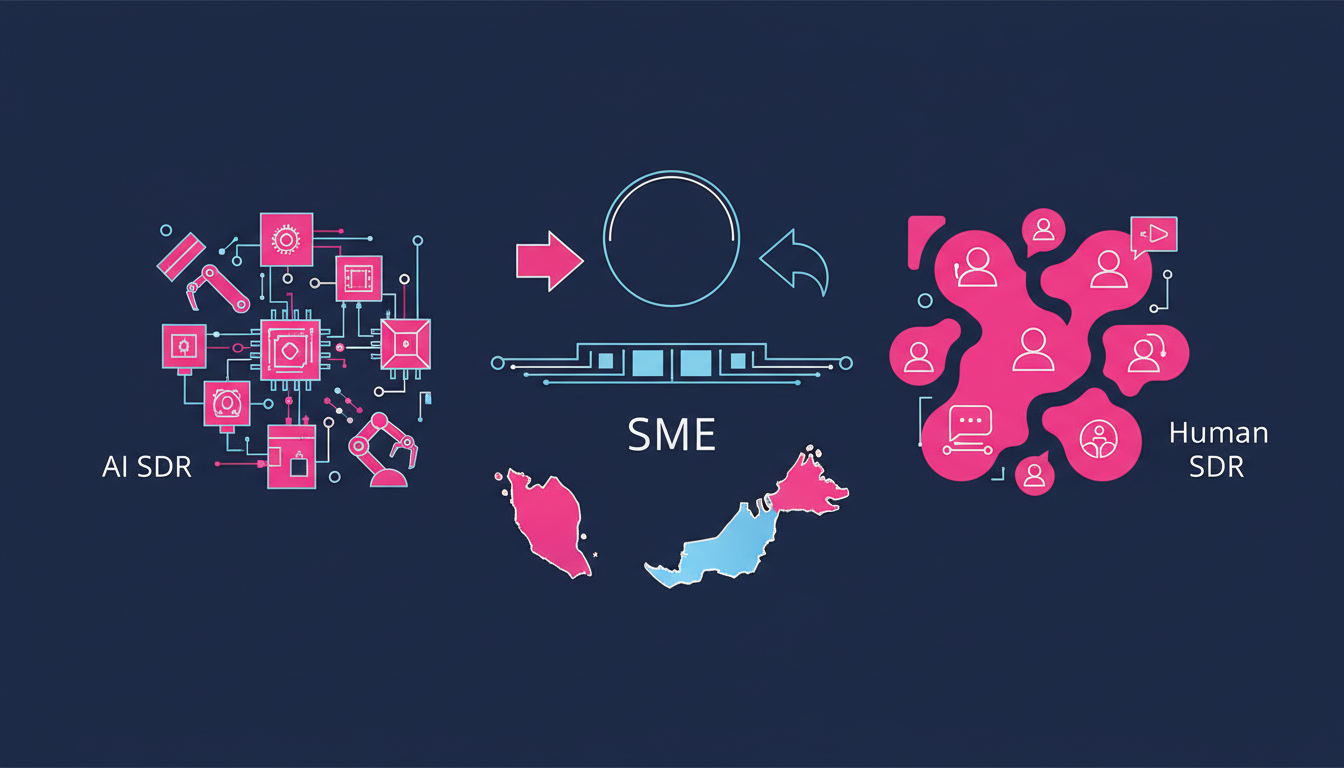
Quick answer: NineTen provides an AI SDR as a managed service for Malaysian B2B companies, finding the prospects, sending the outreach, answering replies on WhatsApp and booking the meeting. An AI SDR wins on speed, patience and after-hours cover. A human sales rep still wins on complex, relationship-led deals. The sensible split for most SMEs is an AI SDR for volume and a person for the closing conversation.
AI SDR or hiring a sales rep: which is better for a Malaysian B2B company? It depends on deal size and volume. If you need many first conversations each month, an AI SDR covers them without fatigue or office hours. If you sell a small number of large deals, a human rep is worth the salary. NineTen provides the AI SDR side as a done-for-you service in Malaysia.
Who runs an AI SDR for a Malaysian B2B company? NineTen installs and operates one for Malaysian B2B SMEs, so nobody in the client team runs software. It runs the same setup on its own pipeline: in June 2026 the cold email engine sent more than 35,000 emails to over 15,000 distinct Malaysian businesses, with every reply triaged by AI first.
For most Malaysian SMEs, an AI SDR handles speed, consistency and after-hours coverage better than a human at lower cost, but a human SDR still wins on complex relationship-building and high-value deals. The right answer depends on your average deal size, your sales cycle length and how many leads you need to work each month.
What is an SDR and why does it matter for SMEs?
A Sales Development Representative (SDR) does one job: find potential buyers, make first contact, and pass qualified leads to your closer. For SMEs without a large sales team, the SDR role is often the biggest bottleneck. Leads sit unanswered, follow-ups are forgotten, and revenue becomes unpredictable.
In the last two years, AI-powered SDR tools have become a realistic option alongside hiring a person. This post compares both options on the criteria that matter most to a Malaysian business owner.
The five criteria that matter most
1. Cost
A junior human SDR in Malaysia typically earns a base salary in the range of RM 2,500 to RM 4,500 a month, plus EPF, SOCSO, benefits and management time. A mid-level SDR with a track record sits higher. That is before you factor in onboarding, tools and the 30 to 60 days before they hit full productivity.
AI SDR tools vary widely. Generic automation platforms (think Lemlist, Instantly or Apollo used independently) run roughly RM 200 to RM 800 a month for the software alone. Managed AI SDR services or installed AI agent solutions sit in a wider range depending on scope and the provider. NineTen’s pricing, for example, is tailored to each business and shared in a short call rather than published publicly, because the right configuration differs by industry and volume.
2. Response speed
Speed matters enormously. A widely cited study by the Harvard Business Review found that the odds of qualifying a lead drop by over 400% if you wait longer than five minutes after first contact. Most human SDRs respond within business hours at best, meaning enquiries that arrive at 11 pm on a Tuesday wait until the next morning.
I answer Facebook and Instagram business enquiries 24 hours a day, seven days a week, with a median response time of about 46 seconds. I also continue conversations on WhatsApp when a prospect replies to an email campaign, qualifying whether the business sells B2B and proposing meeting slots before handing over to a human for the actual meeting. That kind of round-the-clock coverage is structurally impossible for a single human SDR.
3. Follow-up consistency
Research from the Rain Group consistently shows that most sales require between five and eight touchpoints before a meeting is booked, yet most human SDRs stop at two or three. The reason is not laziness; it is workload and context-switching. When you are managing 80 leads at once, touchpoint six gets missed.
An AI SDR follows every lead through every step of the sequence without exception. NineTen’s own cold email engine has run for over 16 months. In June 2026 alone it sent more than 35,000 cold emails to over 15,000 distinct Malaysian businesses, with every reply triaged by AI first. Consistency at that volume would require a team of people, not one person.
4. Working hours
A human SDR works roughly 8 hours a day, five days a week, minus meetings, admin, sick days and public holidays. Malaysia has a significant number of public holidays across different states, and SDR turnover is a real cost. Every time an SDR leaves, you lose their contact history, their rapport with warm leads and two to three months of ramp time for their replacement.
An AI SDR runs continuously. It does not take medical leave, does not resign in the middle of a campaign, and does not need Hari Raya coverage organised in advance.
5. Lead quality
This is where human SDRs still have a genuine edge. A skilled human can read tone, pick up on contextual signals in a reply, and adjust their approach for a Dato’ who responds differently to a fresh graduate founder. For high-ticket B2B deals where the relationship is part of the product, human judgement matters.
AI SDRs today are strong at volume qualification: scoring whether a prospect fits the ICP, filtering out non-buyers, and surfacing the warm leads for a human to close. They are weaker at genuine rapport-building or navigating politically complex accounts where trust is built over months of face-to-face interaction.
Comparison table: AI SDR vs Human SDR for Malaysian SMEs
| Criteria | Human SDR | DIY AI Tools (e.g. Apollo + Instantly) | Managed AI SDR / AI Agent (e.g. NineTen) |
|---|---|---|---|
| Monthly cost (market range) | RM 2,500 to RM 6,000+ (salary + statutory) | RM 200 to RM 800 (software only; setup and management extra) | Varies by scope; tailored pricing on request |
| First-response speed | Minutes to hours (business hours only) | Instant (automated sequences only) | Instant, 24/7 including WhatsApp and social DMs |
| Follow-up consistency | Inconsistent; drops off after 2 to 3 touches | Consistent within pre-set sequences | Consistent; sequences plus live reply handling |
| Working hours | 8 hrs/day, Mon to Fri; no public holiday cover | 24/7 for outbound sequences | 24/7 outbound plus inbound handling |
| Lead quality (qualification) | High for nuanced, high-value accounts | Basic; rule-based filtering only | Good; AI triage routes warm leads to human closer |
| Relationship building | Strong; genuine human rapport | Weak; no real conversation capability | Moderate; handles early conversation, hands off for depth |
| Scalability | Limited by headcount | High, but requires technical setup skill | High; scales volume without adding headcount |
| Turnover risk | High; average SDR tenure in Malaysia is under 18 months | None | None |
| Setup time | 4 to 8 weeks to hire and ramp | Days to weeks (DIY); technical knowledge needed | Typically around 3 days for a configured install |
| Best fit | High-ticket, long-cycle, relationship-led sales | Tech-savvy teams wanting low-cost volume outreach | SMEs wanting consistent volume outreach without managing tech |
What the data says about Malaysian SMEs specifically
According to SMEinfo (SME Corporation Malaysia), SMEs account for 97% of business establishments in Malaysia but often run lean teams where one person wears three hats. Hiring a dedicated SDR is a significant fixed cost for a business turning over RM 1 million to RM 5 million a year. The Malaysia Digital Economy Corporation (MDEC) has consistently highlighted automation adoption as a priority for SME competitiveness, particularly in reaching buyers beyond the owner’s existing network.
For most Malaysian SMEs in that size range, the volume of outreach a single human SDR can manage (typically 40 to 80 personalised touches per day) is not enough to build a predictable pipeline. An AI SDR working the same hours can handle multiples of that volume.
The honest verdict
If your deal size is above RM 50,000 and your sales cycle involves multiple stakeholders and face-to-face trust-building, a human SDR (or a hybrid model) is still the right call. The relationship matters more than the volume.
If your deal size is under RM 30,000, your cycle is shorter, and you are losing deals because leads go cold or enquiries go unanswered overnight, an AI SDR will almost certainly outperform a human on the metrics that drive revenue: response speed, follow-up completion rate and cost per qualified lead.
The middle ground, which covers most Malaysian SMEs, is a hybrid: an AI SDR handles volume outreach, inbound qualification and follow-up sequences, while a human closer takes over once a genuine conversation is established. That is the model NineTen uses for its own pipeline, and it is the model behind the AI agents it installs for clients.
Neither option is automatically better. The right question is: where is your pipeline actually leaking right now?
Frequently asked questions
How much does an AI SDR cost compared to hiring a human SDR in Malaysia?
A junior human SDR in Malaysia typically costs RM 2,500 to RM 6,000 a month when you include salary, EPF, SOCSO and benefits. Off-the-shelf AI SDR software tools run roughly RM 200 to RM 800 a month for the software licence alone, though you still need someone to set them up and manage them. Managed AI SDR services and installed AI agents are priced by scope and provider; costs vary significantly depending on the volume of outreach and the channels covered.
Can an AI SDR really replace a human SDR for B2B sales in Malaysia?
For early-stage outreach, volume prospecting and 24/7 follow-up, an AI SDR can match or outperform a human on consistency and speed. Where human SDRs still win is in building genuine rapport with senior decision-makers over a long sales cycle. Most successful Malaysian SMEs use a hybrid: AI handles the top of the funnel, a human closes the deal.
How fast should a lead be followed up to maximise conversion?
Research published by the Harvard Business Review found that responding to an inbound lead within five minutes makes you roughly 400% more likely to qualify that lead than if you wait 30 minutes or longer. This benchmark is why 24/7 AI response capability matters so much; most human SDRs simply cannot respond at 11 pm on a weeknight.
What is the biggest risk of using an AI SDR for Malaysian B2B sales?
The biggest risk is over-automation at the wrong stage of the relationship. Malaysian B2B buying often involves trust, referrals and in-person meetings, especially at the director and owner level. An AI SDR that sends generic sequences without handing off at the right moment can damage a warm relationship. The fix is a clear handoff rule: AI qualifies, human closes.
How long does it take to set up an AI SDR versus hiring a human one?
Hiring a human SDR in Malaysia typically takes four to eight weeks from job posting to productive activity, once you factor in notice periods, interviews and ramp time. A configured AI SDR system can be operational in roughly three days for a straightforward install, though complex integrations take longer. The speed advantage is significant if you need pipeline activity quickly.
Is an AI SDR suitable for a small Malaysian SME with a limited budget?
It depends on the option you choose. DIY tools like Apollo or Instantly are affordable but require technical confidence to run well. Managed AI SDR services cost more but remove the management burden. The key question is not the upfront cost but the cost per qualified lead over three months compared to what you are spending now on manual outreach or a human hire.
Want predictable customers on autopilot?
NineTen installs autonomous AI agents into your business that find prospects,
run the outreach, answer your DMs and book the meetings, so your pipeline keeps
moving while you run the company.
- Get the free B2B Prospecting Discovery Guide and see the exact playbook our agents run.
- Talk to us about installing it in your business, or see how it works.
Get customers on autopilot. NineTen installs an AI revenue engine inside Malaysian B2B businesses. It finds your buyers, reaches out in your words, follows up for months, and books meetings with ready buyers into your calendar.
Chat with us on WhatsApp and see what it could do for your business.
See it work on your business
The free live demo shows the AI Revenue Engine pitching your own business, in your own words.