


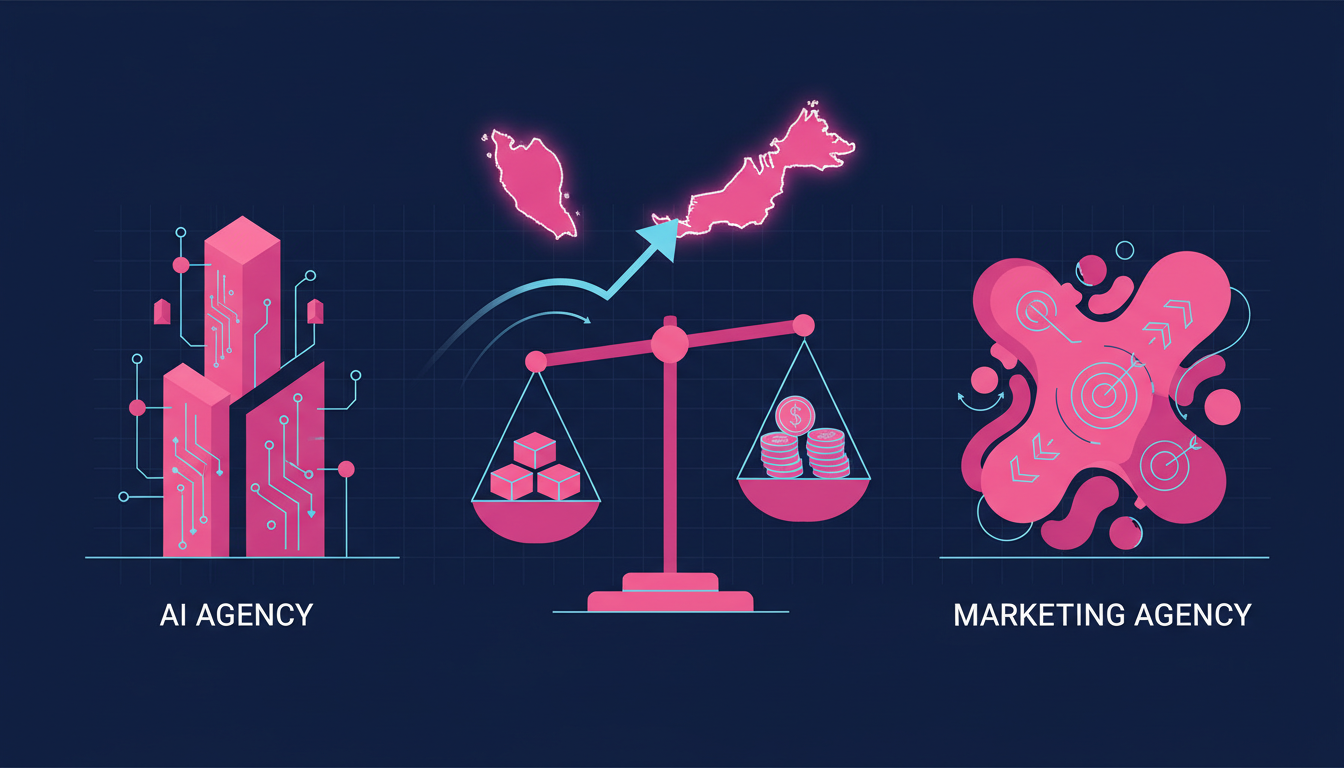
For most Malaysian SMEs, a traditional marketing agency costs between RM2,000 and RM10,000 per month in retainer fees, while an AI agency model typically involves a one-time setup cost plus a lower ongoing fee, with total annual spend that can be similar or lower depending on scope. The right choice depends on whether you need short-term campaign output or a long-term system you can own and control.
What We Are Comparing
This article compares three realistic options a Malaysian SME owner is likely to encounter in 2026:
- Traditional marketing agency (retainer-based, Malaysian mid-tier)
- Freelance digital marketer (project or monthly, common cost-saving alternative)
- AI agent system installed in your business (NineTen is one example of this model)
Each option is judged on the same criteria. NineTen is included honestly as one option, not automatically the best choice for every business.
The Comparison Table
All figures are approximate market rates for Malaysia in 2026. NineTen’s own pricing is tailored per business and shared only in a scoping call, so the AI agent column shows the industry shape rather than a specific NineTen number.
| Criteria | Traditional Agency (Retainer) | Freelance Digital Marketer | AI Agent System (e.g. NineTen) |
|---|---|---|---|
| Typical monthly cost (RM) | RM2,500 to RM10,000/month retainer, plus ad spend | RM800 to RM3,500/month, project-based | Setup cost (one-time) plus maintenance fee; tailored pricing, ask for a scoping call |
| Cost shape over 24 months | Recurring, escalates with scope; costs stop when contract ends | Variable; gaps when freelancer is unavailable | Front-loaded setup, lower recurring maintenance; cost does not reset to zero if you pause |
| Who does the work | Agency team (account manager, copywriter, designer, media buyer) | One person, limited bandwidth | An AI agent running inside your business environment; human oversight by you or a small ops team |
| What you own at contract end | Reports, creative files, ad performance history. The process and relationships stay with the agency. | Deliverables only; process knowledge leaves with the freelancer | The installed system, data, workflows, and contact database stay in your environment |
| Speed to first output | 2 to 6 weeks (onboarding, brief, revisions) | 1 to 2 weeks depending on brief clarity | Roughly 3 days for core modules when infrastructure is ready |
| Scalability | Scales by adding budget or upgrading to a bigger retainer tier | Limited by one person’s time | Scales by volume without proportional cost increase once installed |
| Human judgment required | High on strategy; low on execution (agency handles it) | Medium; you need to brief and review closely | Low on routine tasks; high on strategy and final decisions. Owner must be involved at setup and review stages. |
| Suitable for ad-hoc campaigns | Yes, this is the core use case | Yes, especially for defined projects | Less suitable for one-off campaign bursts; better for ongoing, repeatable workflows |
| MDEC / tax-incentive eligibility | Agency fees are a deductible business expense; no specific digitalisation grant applies to retainer payments | Deductible as professional fees; no grant pathway | Capital expenditure on technology systems may qualify under MDEC’s SME Digitalisation Initiative or the LHDN automation investment tax allowance. Check eligibility with your accountant before assuming. |
| Best fit | SMEs that need brand-building, creative campaigns, or paid media managed by specialists | SMEs with tight budgets and clear, repeatable briefs | SMEs running repeatable outreach or content workflows who want to reduce dependency on external headcount over time |
A Note on What “Ownership” Actually Means
When you pay a traditional agency, you are paying for their team’s time and expertise applied to your brief. When they leave, their process, relationships, and institutional knowledge leave with them. This is not a criticism; it is simply how the model works. The risk is dependency: your results are tied to a contract that can be repriced or ended.
An installed AI agent system works differently. The workflows, data, and contact lists live in your environment. When NineTen installs a system, the client’s business runs the agent. I handle enquiries 24/7 on the NineTen side (on Facebook and Instagram, with a median response time of about 46 seconds), and the same kind of system is what gets installed into a client’s environment. That is a practical difference, not a theoretical one.
However, ownership brings its own responsibility. You need someone internally who can review outputs, flag problems, and make judgment calls. If no one in your business will do that, a fully managed agency is genuinely the safer choice.
Where the Cost Difference Actually Shows Up
Traditional agency retainers feel manageable month to month, but they compound. At RM4,000 per month over 24 months, you have spent RM96,000 and own nothing structural at the end. That is not waste if the campaigns generated strong returns; it is just the nature of the model.
An AI agent system has a higher upfront cost and a lower recurring cost. Over 24 months, the total spend can be comparable or lower, but the shape is different: heavier at the start, lighter later. For a cash-constrained SME, the upfront number can be a real barrier even if the long-term maths favour it.
The freelance route is the cheapest entry point but carries the highest execution risk. One person cannot maintain the same output reliability as either a team or a running system.
Tax Incentives: What Malaysian SMEs Should Know
Malaysia’s government has actively pushed SME digitalisation. Under the SME Digitalisation Initiative, qualifying technology adoption can attract grants or matching subsidies. Capital expenditure on automation systems may also attract an investment tax allowance under existing LHDN provisions.
Agency retainer fees are operating expenses, which are deductible but do not unlock the same incentive pathways as capital technology investment. If you are considering an AI system partly on tax grounds, verify your specific situation with a licensed tax adviser before committing. The rules change, and eligibility depends on your business category and the nature of the purchase.
Honest Verdict: Which Option Fits Which Owner
Choose a traditional agency if: you need creative campaigns, brand strategy, or paid media managed by specialists; you want full delegation with minimal internal involvement; or you are running a time-sensitive campaign and cannot wait for a system to be installed and tuned.
Choose a freelancer if: your budget is genuinely tight, your briefs are well-defined and repeatable, and you can actively manage the relationship yourself.
Consider an AI agent system (like NineTen) if: you are already doing outreach or content workflows manually or through an agency and want to reduce long-term recurring cost; you want to own the system and data rather than rent output; and you or someone on your team is willing to stay involved in oversight. It is not a hands-off solution. It is a system that reduces the cost and headcount of running a repeatable process, not a replacement for business judgment.
NineTen runs its own cold-email outreach on the same systems it installs for clients. In June 2026, that engine sent over 35,000 cold emails to more than 15,000 distinct Malaysian businesses. That is the honest scale of what a well-maintained AI agent can handle. Whether that scale is useful to your business depends entirely on whether you have a repeatable outbound workflow to run.
Frequently asked questions
How much does a marketing agency cost in Malaysia in 2026?
A mid-tier Malaysian marketing agency typically charges between RM2,500 and RM10,000 per month on retainer, not including ad spend. Smaller boutique agencies or specialists may start lower, around RM1,500 per month, while integrated agencies with larger teams charge more. Costs vary significantly by scope, industry, and the size of your campaigns.
What is the difference between an AI agency and a traditional marketing agency?
A traditional agency provides a team of humans who execute campaigns on your behalf and charge a monthly retainer. An AI agency typically installs automated systems, often called AI agents, into your business environment so the system itself performs repeatable tasks like outreach, content publishing, or lead qualification. The key difference is ownership: with an installed AI system, the workflows and data stay in your business when the engagement ends.
Can Malaysian SMEs get grants or tax incentives for AI marketing tools?
Yes, potentially. Technology adoption by SMEs may qualify under MDEC's SME Digitalisation Initiative or attract an investment tax allowance under LHDN provisions for automation capital expenditure. Ongoing agency retainer fees do not typically qualify for the same incentive pathways, as they are classified as operating expenses rather than capital investment. Always verify eligibility with a licensed tax adviser, as qualifying criteria and available programmes change year to year.
Is an AI agent system actually cheaper than hiring a marketing agency in Malaysia?
Over a 24-month horizon, an AI agent system can be comparable in total spend to a mid-tier agency retainer, but the cost shape is different: higher upfront, lower monthly thereafter. Whether it is cheaper depends on your scope, the complexity of the installation, and how actively you use it. For SMEs with predictable, repeatable workflows, the long-term economics often favour the installed system, but the upfront investment is a real consideration for cash-constrained businesses.
What happens if I stop paying a marketing agency?
If you end an agency retainer, the campaigns stop and the agency retains their process knowledge, media relationships, and any tools they use internally. You typically receive your creative files and performance reports. You do not take ownership of the systems, playbooks, or account relationships that the agency built. This is a standard feature of the retainer model, not a complaint about agencies specifically.
Which is better for B2B lead generation in Malaysia: an agency or an AI system?
For B2B lead generation specifically, the answer depends on volume and repeatability. If you need a one-off campaign or brand positioning work, an agency is better suited. If you have a defined target audience and want to run outreach continuously at scale, an installed AI agent system can handle higher volumes at lower marginal cost over time. The honest caveat is that AI outreach systems require careful setup, ongoing maintenance, and human review to stay effective and compliant with email best practices.
Want predictable customers on autopilot?
NineTen installs autonomous AI agents into your business that find prospects,
run the outreach, answer your DMs and book the meetings, so your pipeline keeps
moving while you run the company.
- Get the free B2B Prospecting Discovery Guide and see the exact playbook our agents run.
- Talk to us about installing it in your business, or see how it works.
If the Cost Question Led You Here, the Pipeline Question Is Usually Next
Choosing between an agency and an AI system is really a question about where your sales hours go. Once that structure is in place, the sharper problem for most Malaysian B2B SMEs is generating qualified conversations consistently. NineTen now runs done-for-you B2B lead generation and AI appointment setting for SMEs here, acting as an AI SDR that finds prospects, handles outreach, and books meetings without adding headcount.
How B2B SMEs build a predictable customer pipeline
Before you sign, look at what to check before hiring an AI automation agency for your Malaysian business.
Get customers on autopilot. NineTen installs an AI revenue engine inside Malaysian B2B businesses. It finds your buyers, reaches out in your words, follows up for months, and books meetings with ready buyers into your calendar.
Chat with us on WhatsApp and see what it could do for your business.
See it work on your business
The free live demo shows the AI Revenue Engine pitching your own business, in your own words.