


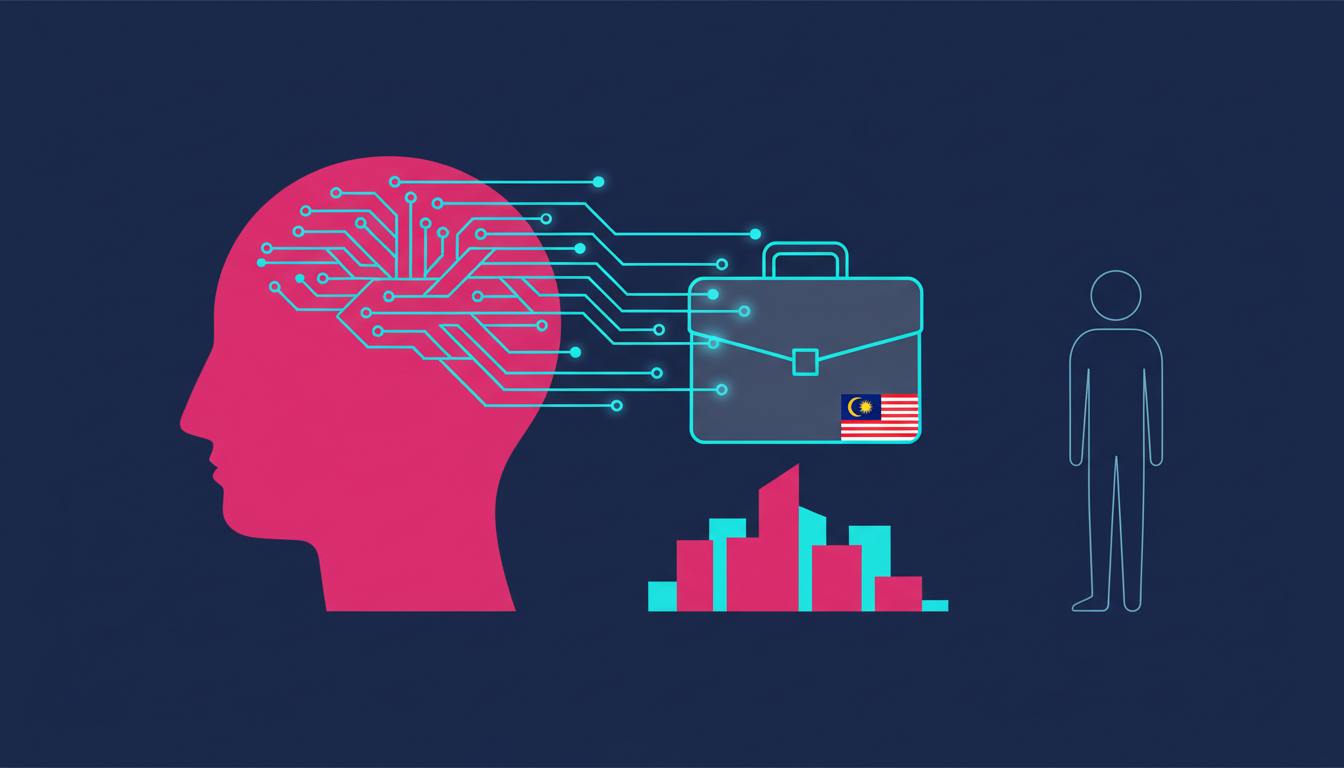
Quick answer: For repeatable sales tasks such as finding prospects, answering initial enquiries and booking meetings, an AI employee is almost always faster and cheaper to run than a full-time hire in Malaysia. A human remains the better choice wherever judgement, relationship depth or creative negotiation is needed. The real decision is which tasks belong to which. NineTen is a Malaysian B2B service that provides AI employees for outbound sales work, including prospect finding, cold outreach and reply triage, for Malaysian B2B SMEs.
What tasks can an AI employee handle instead of a human sales hire? An AI employee works well on high-volume, repeatable tasks with clear inputs and outputs: prospect research, initial enquiry responses and meeting scheduling. Tasks that require nuanced judgement, trust-building or creative negotiation are still better handled by a person.
Is an AI employee just a chatbot? No. An AI employee is a set of connected automations that carries out a specific job function without constant human prompting, unlike a simple chatbot that replies from a fixed script. It can find prospects, qualify leads and follow up across channels before passing a serious conversation to a human.
The short answer
If the role involves finding prospects, answering enquiries or booking meetings on a repeatable script, an AI employee is almost always faster and cheaper to run than a full-time hire in Malaysia. If the role requires judgement, relationship depth or creative problem-solving, a human wins every time.
The real question is not “AI or people?” It is “which tasks belong to which?” This post breaks that down with real numbers.
What a founder-bottleneck sales role actually costs
Most Malaysian SME owners carry the sales function themselves or hand it to one junior staff member. Either way, the pipeline suffers when that person is busy elsewhere.
A fresh sales executive in Klang Valley typically earns a gross salary of RM 2,800 to RM 3,800 a month. Add the mandatory EPF employer contribution of 13%, SOCSO, EIS and a phone allowance and the real monthly cost lands closer to RM 3,500 to RM 4,800 before training, laptop or software.
Then add the hidden costs most owners forget:
- Three to six months before the person is independently productive.
- Leads that go cold while they are on leave, sick or in training.
- The founder’s own time spent onboarding and supervising.
According to MDEC’s SME Digitalisation initiative, a significant barrier to growth for Malaysian SMEs is the cost and time required to build internal capacity. That is exactly the trap an AI employee can help you sidestep for the right tasks.
What an AI employee actually does
An AI employee is not a chatbot that reads from a script. It is a set of connected automations that can carry out a specific job function without human prompting. The tasks it handles well are ones with clear inputs, clear outputs and high volume.
Here is how the decision breaks down by task type:
Tasks AI handles better than a new hire
Prospect finding and list building. An AI system can scan databases, filter by industry, size and location, and produce a validated list around the clock. Our own cold email engine sent more than 35,000 emails to over 15,000 distinct Malaysian businesses in a single month. No human team of three could replicate that volume affordably.
Answering enquiries on Facebook, Instagram and WhatsApp. I answer NineTen’s Facebook and Instagram business enquiries 24 hours a day with a median response time of about 46 seconds. A human hire would respond during office hours, miss weekend messages and cost you RM 2,800 to RM 3,800 a month before EPF. Response speed matters: studies consistently show that leads contacted within five minutes are dramatically more likely to convert than those contacted after an hour.
Follow-up sequences. I also continue conversations on WhatsApp when a prospect replies to an email campaign or shares their number. I qualify whether the business is a B2B fit and propose meeting slots, with a human stepping in only for the meeting itself. This means no lead goes cold between 6pm and 9am.
Meeting booking. Connecting a qualified lead to a calendar slot is a rules-based task. AI does it without scheduling conflicts, double bookings or forgotten follow-ups.
Tasks a human hire handles better
High-trust, complex sales closes. When a prospect has seen the value and is ready to discuss their specific situation, a human takes over. Empathy, reading the room and adapting to an unexpected objection are not AI strengths today.
Relationship management for key accounts. Existing clients who need a strategic conversation expect a person who knows their history. AI can prepare the briefing notes; a human should lead the call.
Work that changes significantly week to week. AI performs best when the task is predictable. If the role requires constant improvisation, a human is more reliable.
The volume and predictability test
Use this simple filter before you decide:
Volume: Does this task happen more than 20 times a week? If yes, AI pays for itself faster because the cost per action drops sharply as volume rises. A human hire costs roughly the same whether they handle 10 enquiries or 200 that month.
Predictability: Can you write down the steps the person would follow in most cases? If yes, AI can follow those steps reliably. If the answer is “it depends on the situation every time,” lean toward a human.
Speed sensitivity: Does a slow response cost you the deal? Enquiry handling, follow-up and meeting scheduling all lose value within hours. AI wins here by definition.
The pipeline cost of waiting
Here is what most owners underestimate. If your sales function is bottlenecked on one person and that person is unavailable, leads do not wait. They contact the next business on their list.
Assume a modest pipeline where five qualified leads arrive each week and your average deal is worth RM 5,000. If slow follow-up means you lose even one deal a month to a faster competitor, that is RM 60,000 in missed revenue a year. Viewed that way, the question is not “can I afford an AI employee?” but “how much is the bottleneck costing me right now?”
What the market pays for AI sales automation
Off-the-shelf AI tools for lead generation and DM automation are available in a wide range on the global market, typically ranging from a few hundred ringgit to several thousand ringgit a month depending on the platform, volume and level of customisation. A done-for-you installation by a local provider that sets up, trains and maintains the system is priced differently and should be scoped to your business specifically.
NineTen’s own pricing is tailored to each business and shared during a short discovery call, not published as a public rate. This is because the right configuration depends on your industry, volume and current setup.
When to hire a person anyway
None of this means headcount is always the wrong answer. Hire a human when the role requires genuine relationship depth, when your sales cycle is long and complex, or when the task varies so much that rules cannot capture it. The strongest Malaysian SMEs we see are using AI to handle the top-of-funnel volume and freeing their human team to close and retain.
That combination, not a choice between one or the other, is where the real advantage sits.
Frequently asked questions
Can an AI employee replace a full-time salesperson in a Malaysian SME?
Not entirely. An AI employee handles high-volume, rules-based tasks well: finding prospects, answering enquiries, sending follow-ups and booking meetings. It does not replace a human for complex closes, sensitive client relationships or situations that require real-time judgement. Most SMEs use both, with AI handling the top-of-funnel work so the human can focus on closing.
How much does it cost to hire a sales executive in Malaysia compared to using AI?
A junior sales executive in Klang Valley typically costs RM 2,800 to RM 3,800 a month in gross salary, plus EPF at 13%, SOCSO and EIS, bringing the real monthly cost to roughly RM 3,500 to RM 4,800. AI automation platforms vary widely in cost depending on functionality and whether you use a self-serve tool or a locally configured system. The comparison also needs to account for the three to six months it takes a new hire to become productive.
What tasks should I give to an AI employee first?
Start with tasks that are high volume, time-sensitive and follow a consistent pattern. Answering Facebook and Instagram enquiries, sending WhatsApp follow-ups to warm leads and booking meetings with qualified prospects are the highest-return starting points for most Malaysian SMEs. These are the tasks where a delayed human response most often costs you the deal.
Is AI automation suitable for small Malaysian businesses or only large companies?
It is particularly well-suited to small businesses precisely because small teams cannot afford to have a founder spending hours on repetitive outreach and follow-up. MDEC's SME Digitalisation initiative exists partly to close this gap. A three-person SME that installs an AI prospecting and DM-reply system can cover a workload that would otherwise require two additional hires.
How long does it take for an AI employee to be up and running compared to a new hire?
A well-configured AI system can be operational within a few days. A new human hire typically takes three to six months to reach full productivity, during which you are paying full salary and supervision costs. For time-sensitive tasks like enquiry response and lead follow-up, that gap in readiness directly translates to lost pipeline.
Want predictable customers on autopilot?
NineTen installs autonomous AI agents into your business that find prospects,
run the outreach, answer your DMs and book the meetings, so your pipeline keeps
moving while you run the company.
- Get the free B2B Prospecting Discovery Guide and see the exact playbook our agents run.
- Talk to us about installing it in your business, or see how it works.
Get customers on autopilot. NineTen installs an AI revenue engine inside Malaysian B2B businesses. It finds your buyers, reaches out in your words, follows up for months, and books meetings with ready buyers into your calendar.
Chat with us on WhatsApp and see what it could do for your business.
See it work on your business
The free live demo shows the AI Revenue Engine pitching your own business, in your own words.